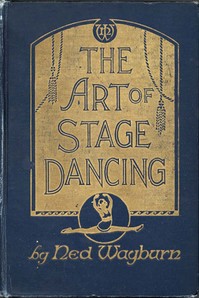
The Art of Stage Dancing.
THE ART OF
STAGE DANCING
The Story of a Beautiful and Profitable Profession
A MANUAL
OF
STAGE-CRAFT
by
NED WAYBURN
Price $5.00
NEW YORK
The Ned Wayburn Studios of Stage Dancing, Inc. PUBLISHERS
Copyright, 1925, by
NED WAYBURN STUDIOS OF STAGE DANCING, INC.
Made in U.S.A.
GREETINGS!
Someway I don't care for the word "Preface." As I think the matter over, I'm not sure that I ever read a preface to any book; and this fact suggests to me that possibly others would pass by this page in my book if I dubbed it by that much-worn and very trite word. So I've hailed you all with a much more cheery and stimulating title for my opening page; and perhaps, in consequence, some may read it.
My Greetings are specially extended to certain chosen groups of people: First, to all students of the past, the present, and those hoped for in the future; second, to the hundreds of teachers of the art of dancing who esteem my original methods of instruction sufficiently to care about what I may print on the subject; and third, to a public that has sat "in front" at any or many of my productions, and enjoyed them, and is, in consequence, interested to know something about the hard work, the thought and the skill, necessary to bring about such pleasing results.
Lest so narrow a limit to my Greetings may be misunderstood, on second thought I will extend my Greetings to that world of people who love life and beauty and happiness; who appreciate honest effort to make living more enjoyable and brighter; who love laughter and smiles and the good things that go with them.
And if all that kind of people will read and appreciate my book, I shall not miss the others.
But still, to them, as well as to you, I extend
Greetings!
NED WAYBURN
An Apology
As a writer of books, I confess myself to be a good stage craftsman.
I have never before attempted authorship, and this volume is simply a spontaneous outpouring of my personal love and knowledge of a great art that has filled my years with joy and happiness, and some renown in the theatrical world.
To have been one modest part of an instrument that has piped to pleasure many millions of my fellows, is surely justification for personal satisfaction. How this playing has been done, how it is being done today in greater degree than ever before, is what I have in mind to tell a curious public.
And so I became an author for this once, and what you may discover that I lack in literary ability, let me trust you will find compensated for in the plainness and simplicity of the facts, incidents and reminiscences that I relate. If not the manner, at least the matter is worthy of your approval.
My story is presented in the first person, and this is because I find it easiest to write from a personal viewpoint--not, I hope, as the result of any special desire to see the letter I in print. A more experienced author would be able to write this book with less suggestion of ego in its pages, I have little doubt, and so I have called this explanatory word An Apology that you may understand why things are as they are, and not demand of the tyro the same quality of literary excellence that you would be justified in expecting of the better qualified writer.
To paraphrase one of my earliest school-boy speeches,--"If this be an apology, make the most of it."
CONTENTS
Page
A Bit of Ancient History 19
Modern Stage Dancing 23
Ned Wayburn--An Inspiration 27
The Ned Wayburn Method of Training 42
Ned Wayburn Stage Dances 57
Ned Wayburn's Foundation Technique 62
Mr. Wayburn Addresses the Beginners' Class in Foundation Technique 75
Ned Wayburn's Musical Comedy Dancing 83
Mr. Wayburn Addresses a Class in Musical Comedy Dancing 90
Ned Wayburn's Tap and Step Dancing (Clogging) 97
Mr. Wayburn Addresses a Class in Tap and Step Dancing 103
Ned Wayburn's Acrobatic Dancing 108
Mr. Wayburn Addresses a Class in Acrobatic Dancing 115
Ned Wayburn's Modern Americanized Ballet Technique 121
Terms Used in Ned Wayburn's Modern Americanized Ballet Technique 130
Mr. Wayburn Addresses the Beginners' Class in Ballet Technique 132
Ned Wayburn's Toe Dancing 137
Ned Wayburn's Specialty Dancing 141
Ned Wayburn's Exhibition Dancing 144
Ned Wayburn's Professional Stage Makeup 146
Stage Costumes 165
Dancing Tempos 169
Diet and Dancing 178
Dancing and Good Health 195
Showmanship 198
"Who's Who" in the Show 203
Professional Coaching and Producing for Amateur Entertainments 216
Private Instruction 239
Experience 241
Inspiration 246
Atmosphere 251
Dancing Children 254
Dancing Hands 259
Dancing Feet 262
Dancing Shoes 265
The Quest of Beauty 270
Who's Afraid! (Stage Fright) 273
The Dance and the Drama 278
Personality in the Dance 280
Dancing and Ease of Manner 284
Dancing and Civilization 286
Dancing and Cheerfulness 290
Dancing and Country Life 293
Dancing as a Social Accomplishment 297
Universal Appreciation of the Dance 299
The Melting Pot of the Dance 301
Your Opportunities 303
Stage-craft 307
Making a Name 317
Forms of Stage Contracts 327
LIST OF HALFTONE PLATES
All portraits are of artists whose careers have been directed by Ned Wayburn.
All stage scenes are of productions staged by Ned Wayburn.
All interior views are of classrooms and other departments of the Ned Wayburn Studios of Stage Dancing, Inc., 1841 Broadway (at Columbus Circle), entrance on 60th Street, New York City.
Photographs used by courtesy of Art Studios and Art Photographers whose names are appended.
* * * * *
Ned Wayburn (White Studio, N.Y.).
Gilda Gray and Ned Wayburn Pupils in "It's Getting Darker on Broadway," Follies of 1922.
One View of Grand Ball Room in Ned Wayburn Studios.
Lace Ballet, Follies of 1922.
The Fairbanks Twins, in the "Follies," and Stars of "Two Little Girls in Blue" (White Studio, N.Y.).
Oscar Shaw, Featured with "Good Morning, Dearie," "The Music Box Revue," "Two Little Girls in Blue," etc. (White Studio, N.Y.).
Dolly Sisters, Internationally Famous Musical Comedy Stars (Alfred Cheney Johnston, N.Y.).
One of over Twenty Daily Dancing Classes at the Ned Wayburn Studios.
Vivienne Segal, Prima Donna of the "Follies" and many other Musical Comedies, Featured in Light Opera (White Studio, N.Y.).
Paulette Duval and Ned Wayburn Pupils, Follies of 1923.
Class in Dancing Foundation Technique at the Ned Wayburn Studios.
Louise Groody, Featured with "Good Morning, Dearie," "No, No, Nanette," etc. (White Studio, N.Y.).
Partial View of Demi-Tasse Theatre, Ned Wayburn Studios.
Conditioning Class in the Ned Wayburn Studios.
The Astaires, Fred and Adele, Featured in "Lady, Be Good!" in America, and in "Stop Flirting," London (White Studio, N.Y.).
Cecil Lean, Featured in "No, No, Nanette," "The Time, the Place and the Girl," "The Blue Paradise," etc. (Apeda, N.Y.).