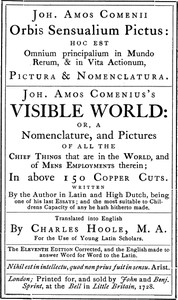
[Transcriber's Note:
This text is intended for users whose text readers cannot use the "real" (Unicode/UTF-8) version of the file. There are two main changes:
--The "oe" ligature, used in the original Latin text, has been unpacked to its separate letters. The "oe" sequence (words such as "coeuntia") does not occur. --The two sections numbered CIV used astrological symbols. When a symbol was used in addition to text such as a planet name, it is shown as empty brackets in its original location: Mercury []. When a symbol was used instead of text it is shown in brackets: [Mercury].
In the Orbis Pictus text, apparent errors in punctuation and typography (such as Italic type where Roman is expected) were unchanged except in chapter headers. Other errors, whether corrected or not, are listed at the end of the e-text. Note that "Dutch" generally means "German".
The original text was printed in parallel columns with English on the left. For this e-text the English and the Latin are shown in small blocks with differing indentation. Line breaks are approximately but not exactly the same as in the original.]
The
ORBIS PICTUS
of
JOHN AMOS COMENIUS.
This work is, indeed, the first children's picture book. --ENCYCLOPÆDIA BRITANNICA, 9TH EDITION, vi. 182.
[Publisher's Device: School Bulletin Publications 1874]
SYRACUSE, N.Y.: C. W. BARDEEN, PUBLISHER, 1887.
Copyright, 1887, by C. W. BARDEEN.
It may not be generally known that Comenius was once solicited to become President of Harvard College. The following is a quotation from Vol. II, p. 14, of Cotton Mather's MAGNALIA:
"That brave old man, Johannes Amos Commenius, the fame of whose worth has been TRUMPETTED as far as more than three languages (whereof everyone is indebted unto his JANUA) could carry it, was indeed agreed withal, by one Mr. Winthrop in his travels through the LOW COUNTRIES, to come over to New England, and illuminate their Colledge and COUNTRY, in the quality of a President, which was now become vacant. But the solicitations of the Swedish Ambassador diverting him another way, that incomparable Moravian became not an American."
This was on the resignation of President Dunster, in 1654--Note of Prof. PAYNE, Compayre's History of Education, Boston, 1886, p. 125.
EDITOR'S PREFACE.
When it is remembered that this work is not only an educational classic of prime importance, but that it was the first picture-book ever made for children and was for a century the most popular text-book in Europe, and yet has been for many years unattainable on account of its rarity, the wonder is, not that it is reproduced now but that it has not been reproduced before. But the difficulty has been to find a satisfactory copy. Many as have been the editions, few copies have been preserved. It was a book children were fond of and wore out in turning the leaves over and over to see the pictures. Then as the old copper-plates became indistinct they were replaced by wood-engravings, of coarse execution, and often of changed treatment. Von Raumer complains that the edition of 1755 substitutes for the original cut of the Soul, (No. 43, as here given,) a picture of an eye, and in a table the figures I. I. II. I. I. II., and adds that it is difficult to recognize in this an expressive psychological symbol, and to explain it. In an edition I have, published in Vienna in 1779, this cut is omitted altogether, and indeed there are but 82 in place of the 157 found in earlier editions, the following, as numbered in this edition, being omitted:
1, the alphabet, 2, 36, 43, 45, 66, 68, 75, 76, 78-80, 87, 88, 92-122, 124, 126, 128, 130-141.
On the other hand, the Vienna edition contains a curious additional cut. It gives No. 4, the Heaven, practically as in this edition, but puts another cut under it in which the earth is revolving about the sun; and after the statement of Comenius, "Coelum rotatur, et ambit terram, in medio stantem" interpolates: "prout veteres crediderunt; recentiores enim defendunt motum terrae circa solem" [as the ancients used to think; for later authorities hold that the motion of the earth is about the sun.]
Two specimen pages from another edition are inserted in Payne's Compayré's History of Education (between pp. 126, 127). The cut is the representative of No. 103 in this edition, but those who compare them will see not only how much coarser is the execution of the wood-cut Prof. Payne has copied, but what liberties have been taken with the design. The only change in the Latin text, however, is from Designat Figuras rerum in the original, to Figuram rerum designat.
In this edition the cuts are unusually clear copies of the copper-plates of the first edition of 1658, from which we have also taken the Latin text. The text for the English translation is from the English edition of 1727, in which for the first time the English words were so arranged as to stand opposite their Latin equivalents.
The cuts have been reproduced with great care by the photographic process. I thought best not to permit them to be retouched, preferring occasional indistinctness to modern tampering with the originals that would make them less authentic.
The English text is unchanged from that of the 1727 edition, except in rare instances where substitutions have been made for single words not now permissible. The typography suggests rather than imitates the quaintness of the original, and the paper was carefully selected to produce so far as practicable the impression of the old hand-presses.
In short my aim has been to put within the reach of teachers at a moderate price a satisfactory reproduction of this important book; and if the sale of the Orbis Pictus seems to warrant it, I hope subsequently to print as a companion volume the Vestibulum and Janua of the same author, of which I have choice copies.
C. W. BARDEEN.
Syracuse, Sept. 28, 1887.
COMMENTS UPON THE ORBIS PICTUS.
During four years he here prosecuted his efforts in behalf of education with commendable success, and wrote, among other works, his celebrated Orbis Pictus, which has passed through a great many editions, and survived a multitude of imitations. --SMITH'S HISTORY OF EDUCATION, N.Y., 1842, p. 129.
The most eminent educator of the seventeenth century, however, was John Amos Comenius...... His Orbis Sensualium Pictus, published in 1657, enjoyed a still higher renown. The text was much the same with the Janua, being intended as a kind of elementary encyclopædia; but it differed from all previous text-books, in being illustrated with pictures, on copper and wood, of the various topics discussed in it. This book was universally popular. In those portions of Germany where the schools had been broken up by the "Thirty years' war," mothers taught their children from its pages. Corrected and amended by later editors, it continued for nearly two hundred years, to be a text-book of the German schools. --HISTORY AND PROGRESS OF EDUCATION, BY PHILOBIBLIUS, N.Y., 1860, p. 210.
The "Janua" would, therefore, have had but a short-lived popularity with teachers, and a still shorter with learners, if Comenius had not carried out his principle of appealing to the senses, and called in the artist. The result was the "Orbis Pictus," a book which proved a favorite with young and old, and maintained its ground in many a school for more than a century.... I am sorry I cannot give a specimen of this celebrated book with its quaint pictures. The artist, of course, was wanting in the technical skill which is now commonly displayed even in the cheapest publications, but this renders his delineations none the less entertaining. As a picture of the life and manners of the seventeenthcentury, the work has great historical interest, which will, I hope, secure for it another English edition. --QUICK'S EDUCATIONAL REFORMERS, 1868; Syracuse edition, p. 79.
But the principle on which he most insisted is that the teaching of words and things must go together, hand in hand. When we consider how much time is spent over new languages, what waste of energy is lavished on mere preparation, how it takes so long to lay a foundation that there is no time to lay a building upon it, we must conclude that it is in the acceptance and development of this principle that the improvement of education will in the future consist. Any one who attempts to inculcate this great reform will find that its first principles are contained in the writings of Comenius. --ENCYCLOPAEDIA BRITANNICA, 9th edition, vii. 674.
The first edition of this celebrated book was published at Nuremberg in 1657; soon after a translation was made into English by Charles Hoole. The last English edition appeared in 1777, and this was reprinted in America in 1812. This was the first illustrated school-book, and was the first attempt at what now passes under the name of "object lessons." --SHORT HISTORY OF EDUCATION, W. H. PAYNE, Syracuse, 1881, p. 103.
Of these, the "Janua" and the "Orbis" were translated into most European and some of the Oriental languages. It is evident that these practices of Comenius contain the germs of things afterwards connected with the names of Pestalozzi and Stow. It also may be safely assumed that many methods that are now in practical use, were then not unknown to earliest teachers. --GILL'S SYSTEMS OF EDUCATION, London, 1876, p. 13.