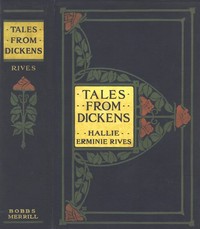
TALES FROM DICKENS
By
HALLIE ERMINIE RIVES
Author of The Castaway, Hearts Courageous A Furnace of Earth, etc.
With Illustrations by Reginald B. Birch
Indianapolis The Bobbs-Merrill Company Publishers
Copyright 1905 The Bobbs-Merrill Company November
To
GEORGE BAKER ROBBINS, JR.
CONTENTS
CHARLES DICKENS 1
THE OLD CURIOSITY SHOP
I Little Nell 19 II The Wanderers 26 III The Search 35
OLIVER TWIST
I How Oliver Came to London and What He Found There 49 II Oliver's Adventures 58 III How Everything Turned Out Right for Oliver in the End 65
BARNABY RUDGE
I Barnaby's Boyhood 77 II The Mysterious Stranger and Who He Was 83 III Barnaby Gets Into Trouble 89 IV Barnaby Prospers at Last 95
DAVID COPPERFIELD
I David's Early Ups and Downs 105 II Little Em'ly 115 III David and His Child-Wife 120 IV David Finds All Well at Last 124
GREAT EXPECTATIONS
I Pip and the Convict 131 II The Queer Miss Havisham 138 III Pip Discovers His Benefactor 147 IV Pip Comes to Himself 152
NICHOLAS NICKLEBY
I Nicholas at Dotheboys Hall 161 II Nicholas Becomes an Actor 167 III Nicholas Comes to Kate's Rescue 171 IV What Happened to Everybody 175
DOMBEY AND SON
I Little Paul 183 II How Florence Lost Her Father 191 III How Florence Reached a Refuge 199 IV How Florence Found Her Father at Last 203
THE PICKWICK PAPERS
I The Pickwickians Begin Their Adventures. They Meet Mr. Alfred Jingle, and Winkle Is Involved in a Duel 213 II Tupman Has a Love-Affair With a Spinster, and the Pickwickians Find Out the Real Character of Jingle 218 III Mr. Pickwick Has an Interesting Scene With Mrs. Bardell, His Housekeeper. Further Pursuit of Jingle Leads to an Adventure at a Young Ladies' Boarding School 224 IV Sam Weller Meets His Father, and the Pursuit of Jingle Is Continued. Mr. Pickwick Makes a Strange Call on a Middle-Aged Lady in Yellow Curl Papers 230 V The Pickwickians Find Themselves in the Grasp of the Law. The Final Exposure of Jingle, and a Christmas Merrymaking 233 VI The Celebrated Case of Bardell Against Pickwick. Sergeant Buzfuz's Speech and an Unexpected Verdict 238 VII Winkle Has an Exciting Adventure With Mr. Dowler, and With the Aid of Mr. Pickwick and Sam Weller Discovers the Whereabouts of Miss Arabella Allen 242 VIII Mr. Pickwick's Experiences in the Debtors' Prison, Where He Finds an Old Enemy and Heaps Coals of Fire on the Head of Mrs. Bardell 248 IX Snodgrass Gets Into Difficulties, But Wins His Lady-Love. The Adventures of the Pickwickians Come to an End 252
LITTLE DORRIT
I How Arthur Came Home from China 261 II The Child of the Marshalsea 266 III What Riches Brought to the Dorrits 274 IV What Happened to Arthur Clennam 280 V "All's Well That Ends Well" 284
MARTIN CHUZZLEWIT
I How Martin Left England 295 II Pecksniff and Old Chuzzlewit 302 III Jonas Gets Rid of an Enemy 308 IV What Came of Martin's Trip to America 313 V Old Chuzzlewit's Plot Succeeds 318
OUR MUTUAL FRIEND
I What Happened to John Harmon 325 II Lizzie Hexam and the Dolls' Dressmaker 332 III The Rise and Fall of Silas Wegg 337 IV Bella and the Golden Dustman 343 V The End of the Story 348
A TALE OF TWO CITIES
I How Lucie Found a Father 357 II Darnay Caught in the Net 367 III Sydney Carton's Sacrifice 375
BLEAK HOUSE
I The Court of Chancery 383 II Lady Dedlock's Secret 390 III Little Joe Plays a Part 398 IV Esther Becomes the Mistress of Bleak House 405
HARD TIMES
I Mr. Gradgrind and His "System" 413 II The Robbery of Bounderby's Bank 420 III Harthouse's Plan Fails 427 IV Stephen's Return 432
THE MYSTERY OF EDWIN DROOD
I John Jasper 441 II The Coming of Neville Landless 444 III The Choirmaster's Dinner 449 IV Jasper Shows His Teeth 455
INDEX TO CHARACTERS 463
TALES FROM DICKENS
CHARLES DICKENS
Charles John Huffham Dickens, the master story-teller, was born in Landport, England, February 7, 1812. His father was a clerk in one of the offices of the Navy, and he was one of eight children.
When he was four years old, his father moved to the town of Chatham, near the old city of Rochester. Round about are chalk hills, green lanes, forests and marshes, and amid such scenes the little Charles's genius first began to show itself.
He did not like the rougher sports of his school-fellows and preferred to amuse himself in his own way, or to wander about with his older sister, Fanny, whom he especially loved. They loved to watch the stars together, and there was one particular star which they used to pretend was their own. People called him a "very queer small boy" because he was always thinking or reading instead of playing. The children of the neighborhood would gather around him to listen while he told them stories or sang comic songs to them, and when he was only eight years old he taught them to act in plays which he invented. He was fond of reading books of travel, and most of all he loved The Arabian Nights and Robinson Crusoe.
He had a great affection for Chatham and Rochester, and after he began to write stories that were printed, he often used to put these places into them. It was at Chatham that poor little David in the story, David Copperfield, lay down to sleep when he was running away from London to find his aunt, Miss Betsy Trotwood. It was to Rochester that Mr. Pickwick in Pickwick Papers, rode with Jingle. Rochester was really the "Cloisterham" where the wicked choir master, John Jasper, killed his nephew, in The Mystery of Edwin Drood. And it was in those very marshes near by, that Magwitch, the escaped convict in Great Expectations, so frightened little Pip. It is easy to see that the young Charles Dickens noted carefully and remembered everything he saw, and this habit was of great use to him all his life.
These happy years were not to last long. When he was nine years old, his father became poor and the family was obliged to move to London, where it lived in a shabby house in a poor suburb. Before another year had passed, his father was put into prison for debt--the same prison in which Little Dorrit, in the story of that name, grew up. A very bitter period followed for the solitary ten-year-old boy--a time in which, he long afterward wrote, "but for the mercy of God, he might easily have become, for any care that was taken of him, a little robber or a little vagabond." The earlier history of David in David Copperfield is really and truly a history of the real Charles Dickens in London. He was left to the city streets, or to earn a hard and scanty living in a dirty warehouse, by pasting labels on pots of blacking. All of this wretched experience he has written in David Copperfield, and the sad scenes of the debtors' prison he has put into Pickwick Papers and into Little Dorrit. Even Mrs. Pipchin, of whom he told in Dombey and Son, and Mr. Micawber in David Copperfield, were real people whom he knew in these years of poverty and despair. Dickens's life at this time was so miserable that always afterward he dreaded to speak of it, and never could bear even to walk in the street where the blacking warehouse of his boyhood had stood.
Better days, however, came at last. He was able to begin school again, and though the head-master was ignorant and brutal (just such a one as Mr. Creakle in David Copperfield) yet Dickens profited by such teaching as he received.