TRANSCRIBER'S NOTE:
A. This text uses UTF-8 (unicode) file encoding. If the apostrophes and quotation marks in this paragraph appear as garbage, you may have an incompatible browser or unavailable fonts. First, make sure that your browser’s “character set” or “file encoding” is set to Unicode (UTF-8). You may also need to change the default font.
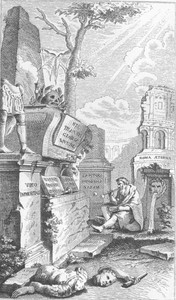
FRONTISPIECE TO POPE'S WORKS, VOL. II.
THE WORKS OF ALEXANDER POPE.
NEW EDITION.
INCLUDING
SEVERAL HUNDRED UNPUBLISHED LETTERS, AND OTHER NEW MATERIALS.
COLLECTED IN PART BY THE LATE
RT. HON. JOHN WILSON CROKER.
WITH INTRODUCTIONS AND NOTES.
BY REV. WHITWELL ELWIN.
VOL. II. POETRY.--VOL. II.
WITH PORTRAITS AND OTHER ILLUSTRATIONS.
LONDON: JOHN MURRAY, ALBEMARLE STREET. 1871.
[_The right of Translation is reserved._]
LONDON: BRADBURY, EVANS, AND CO., PRINTERS, WHITEFRIARS.
* * * * *
AN
ESSAY ON CRITICISM.
WRITTEN IN THE YEAR 1709.
* * * * *
AN ESSAY ON CRITICISM,
4to.
----Si quid novisti rectius istis, Candidus imperti; si non, his utere mecum.--HORAT.
London: Printed for W. LEWIS, in Russel-Street, Covent Garden; and sold by W. TAYLOR, at the Ship, in Pater-Noster-Row, T. OSBORN, in Gray's-Inn, near the Walks, and J. GRAVES, in St. James's Street. 1711.
Warton says that the poem was "first advertised in the Spectator, No. 65, May 15th, 1711." Pope informed Caryll that a thousand copies were printed. Lewis, the publisher, was a Roman Catholic, and an old schoolfellow of the poet.
* * * * *
AN ESSAY ON CRITICISM.
Written by Mr. POPE.
The second edition, 8vo.
London: Printed for W. LEWIS, in Russel-Street, Covent Garden, 1713.
Though the date on the title page is 1713, Isaac Reed states that the second edition was advertised in the Spectator on November 22, 1712. It was a common practice to substitute the date of the coming, for that of the expiring, year. A third and fourth edition in a smaller type and size came out in 1713. In 1714, the poem was appended to the second edition of Lintot's Miscellanies, by some arrangement with Lewis, whose name appears upon the title page of that particular edition of the Miscellanies as joint publisher. On July 17, 1716, Lintot purchased the remainder of the copyright for £15, preparatory to inserting the piece in the quarto of 1717. He brought out a sixth octavo edition of the essay in 1719, and a seventh in 1722, and reprinted the poem in each of the four editions of his Miscellanies which were published between 1720 and 1732.
* * * * *
AN ESSAY ON CRITICISM.
Written in the year 1709. With the Commentary and Notes of W. WARBURTON, A.M. 4to.
The Essay on Criticism has no date, but on the title page of the "Essay on Man," which appeared in the same volume is, "London: Printed by W. BOWYER for M. COOPER, at the Globe in Pater-Noster Row. 1743." Pope, writing to Warburton on October 7, 1743, says, "I have given Bowyer your comment on the Essay on Criticism this week, and he shall lose no time with the rest." On Jan. 12, 1744, he tells his commentator that the publication had been delayed by the advice of Bowyer, and on Feb. 21, he writes word that he shall keep it back till Warburton goes to town. There is no doubt that the edition was printed in 1743, and published in 1744.
* * * * *
In the year 1709 was written the Essay on Criticism, a work which displays such extent of comprehension, such nicety of distinction, such acquaintance with mankind, and such knowledge both of ancient and modern learning, as are not often attained by the maturest age and longest experience. It was published about two years afterwards, and being praised by Addison in the Spectator, with sufficient liberality, met with so much favour as enraged Dennis, "who," he says, "found himself attacked without any manner of provocation on his side, and attacked in his person, instead of his writings, by one who was wholly a stranger to him, at a time when all the world knew he was persecuted by fortune; and not only saw that this was attempted in a clandestine manner, with the utmost falsehood and calumny, but found that all this was done by a little affected hypocrite, who had nothing in his mouth at the same time but truth, candour, friendship, goodnature, humanity, and magnanimity." How the attack was clandestine is not easily perceived, nor how his person is depreciated; but he seems to have known something of Pope's character, in whom may be discovered an appetite to talk too frequently of his own virtues. Thus began the hostility between Pope and Dennis, which, though it was suspended for a short time, never was appeased. Pope seems, at first, to have attacked him wantonly; but though he always professed to despise him, he discovers, by mentioning him very often, that he felt his force or his venom.
Of this Essay Pope declared that he did not expect the sale to be quick, because "not one gentleman in sixty, even of liberal education, could understand it." The gentlemen and the education of that time seem to have been of a lower character than they are of this. He mentioned a thousand copies as a numerous impression. Dennis was not his only censurer. The zealous papists thought the monks treated with too much contempt, and Erasmus too studiously praised; but to these objections he had not much regard. The Essay has been translated into French by Hamilton, author of the Comte de Grammont, whose version was never printed; by Robotham, secretary to the king for Hanover, and by Resnel; and commented by Dr. Warburton, who has discovered in it such order and connection as was not perceived by Addison, nor, as is said, intended by the author. Almost every poem consisting of precepts is so far arbitrary and immethodical, that many of the paragraphs may change places with no apparent inconvenience; for of two or more positions, depending upon some remote and general principle, there is seldom any cogent reason why one should precede the other. But for the order in which they stand, whatever it be, a little ingenuity may easily give a reason. "It is possible," says Hooker, "that, by long circumduction from any one truth, all truth may be inferred." Of all homogeneous truths, at least of all truths respecting the same general end, in whatever series they may be produced, a concatenation by intermediate ideas may be formed such as, when it is once shown, shall appear natural; but if this order be reversed, another mode of connection equally specious may be found or made. Aristotle is praised for naming fortitude first of the cardinal virtues, as that without which no other virtue can steadily be practised; but he might with equal propriety have placed prudence and justice before it, since without prudence fortitude is mad, without justice it is mischievous. As the end of method is perspicuity, that series is sufficiently regular that avoids obscurity, and where there is no obscurity, it will not be difficult to discover method.
The Essay on Criticism is one of Pope's greatest works, and if he had written nothing else, would have placed him among the first critics and the first poets, as it exhibits every mode of excellence that can embellish or dignify didactic composition--selection of matter, novelty of arrangement, justness of precept, splendour of illustration, and propriety of digression. I know not whether it be pleasing to consider that he produced this piece at twenty, and never afterwards excelled it. He that delights himself with observing that such powers may be soon attained, cannot but grieve to think that life was ever after at a stand. To mention the particular beauties of the essay, would be unprofitably tedious; but I cannot forbear to observe that the comparison of a student's progress in the sciences with the journey of a traveller in the Alps, is perhaps the best that English poetry can show. A simile, to be perfect, must both illustrate and ennoble the subject; must show it to the understanding in a clearer view, and display it to the fancy with greater dignity; but either of these qualities may be sufficient to recommend it. In didactic poetry, of which the great purpose is instruction, a simile may be praised which illustrates though it does not ennoble; in heroics that may be admitted which ennobles, though it does not illustrate. That it may be complete, it is required to exhibit, independently of its references, a pleasing image; for a simile is said to be a short episode. To this antiquity was so attentive, that circumstances were sometimes added which, having no parallels, served only to fill the imagination, and produced what Perrault ludicrously called "comparisons with a long tail." In their similes the greatest writers have sometimes failed. The ship race compared with the chariot race, is neither illustrated nor aggrandised; land and water make all the difference. When Apollo, running after Daphne, is likened to a greyhound chasing a hare, there is nothing gained; the ideas of pursuit and flight are too plain to be made plainer, and a god and the daughter of a god, are not represented much to their advantage by a hare and a dog. The simile of the Alps has no useless parts, yet affords a striking picture by itself; it makes the foregoing position better understood, and enables it to take faster hold on the attention; it assists the apprehension, and elevates the fancy.