Transcriber's note:
Text enclosed by underscores is in italics (italics). Non-italicized text within italic text is enclosed by carat characters (example: _and ~Soldiers~. They pass over the stage_)
A carat character is used to denote superscription. A single character following the carat is superscripted (example: xxxx^s).
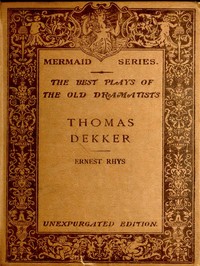
The Mermaid Series.
Edited by Havelock Ellis.
THE BEST PLAYS OF THE OLD DRAMATISTS.
THOMAS DEKKER.
* * * * *
In Half-Crown Monthly Volumes uniform with the present Work.
THE MERMAID SERIES.
THE BEST PLAYS OF THE OLD DRAMATISTS.
The following comprise the earlier Volumes of the series:--
MARLOWE. Edited by HAVELOCK ELLIS. With a General Introduction by J. A. SYMONDS.
MASSINGER. Edited by ARTHUR SYMONS.
MIDDLETON. With an Introduction by A. C. SWINBURNE.
BEAUMONT AND FLETCHER (2 vols.). Edited by J. ST. LOE STRACHEY.
CONGREVE. Edited by ALEXANDER C. EWALD.
DEKKER. Edited by ERNEST RHYS.
NERO AND OTHER PLAYS. Edited by H. P. HORNE, etc.
WEBSTER & CYRIL TOURNEUR. Edited by J. A. SYMONDS.
SHIRLEY. Edited by EDMUND GOSSE.
BEN JONSON (2 vols.). Edited by C. H. HERFORD.
OTWAY. Edited by the Hon. RODEN NOEL.
THOMAS HEYWOOD. Edited by J. A. SYMONDS.
FORD. Edited by HAVELOCK ELLIS.
ARDEN OF FEVERSHAM, and other Plays attributed to SHAKESPEARE. Edited by ARTHUR SYMONS.
* * * * *
The Best Plays of the Old Dramatists.
THOMAS DEKKER
Edited, with an Introduction and Notes, by Ernest Rhys.
“I lie and dream of your full Mermaid wine.”--Beaumont.
UNEXPURGATED EDITION.
London: Vizetelly & Co., 42, Catherine St., Strand. 1887.
“What things have we seen Done at the Mermaid! heard words that have been So nimble, and so full of subtle flame, As if that every one from whence they came Had meant to put his whole wit in a jest, And had resolved to live a fool the rest Of his dull life.”
Master Francis Beaumont to Ben Jonson.
“Souls of Poets dead and gone, What Elysium have ye known, Happy field or mossy cavern, Choicer than the Mermaid Tavern?”
Keats.
LONDON: BRADBURY, AGNEW, & CO., PRINTERS, WHITEFRIARS.
CONTENTS.
PAGE THOMAS DEKKER vii
THE SHOEMAKER’S HOLIDAY 1
THE HONEST WHORE.--Part the First 89
THE HONEST WHORE.--Part the Second 191
OLD FORTUNATUS 287
THE WITCH OF EDMONTON 387
THOMAS DEKKER.
IN Henslowe’s Diary, among the curious items which Alleyn’s fellow manager in the Fortune and other theatres set down concerning his transactions in the plays of the time, the name of a certain “Mr. Dickers,” will be found under date 8th of January, 1597. In this way, the adventure of Thomas Dekker into the precarious field of dramatic authorship is first recorded for us. The entry refers to some twenty shillings “lent unto Thomas Dowton” to buy a book of Dekker’s, no doubt the MS. of some play written by him, the name of which, however, is not given. A week later, a second entry notes again a disbursement, this time of four pounds, also for a book of his “called Fayeton” (Phaeton), possibly a further part of the same work. The third entry referring to him is ominous: “Lent unto the companey, the 4 of febreary 1598, to disecharge Mr. Dicker owt of the cownter in the powltrey, the some of fortie shillings. I saye dd to Thomas Dowton ... xxxx^s.” In the sorry indication of these three entries, showing first the promising emergence of the young playwright, and then immediately the coming of disaster upon him, and his being lodged for debt in “the Counter in the Poultry,” we have at once the key to Dekker’s career. Dekker, perhaps the most original and most striking figure among the lesser known men of that brilliant array which follows Marlowe, is at the same time one of the most unfortunate in his life and its artistic outcome, judged by the standard of his own genius. It was as if Fortune, to take a figure from his own play, having first presented him with the gift which, as a poet of the time, he most desired,--the playwright’s great opportunity, then turned upon him, and said,--
“But now go dwell with cares, and quickly die.”
If, however, he lived with cares, he laughed at them, and he was too strong to let them kill him outright. But, nevertheless, there they were; they never perhaps quite upset that undaunted good-humour of his, but they defeated him as an artist, they allied themselves insidiously with his own natural weaknesses to defeat the consummation of a really great poetic faculty.
Dekker, however, is one of those authors whose personal effect tends to outgo the purely artistic one. He has the rare gift of putting heart into everything he says, and because of this abounding heartiness of his, it is hard to measure him by the absolute standards of criticism. Indeed, after the endless shortcomings and disappointments of his verse and prose have been estimated and written against him, he remains, after all has been set down, still the same lovable, elusive being, a man of genius, a child of nature. For this reason, it is disappointing that so little is to be actually known of his life. As one reads his plays, and marks the strong individuality shown in them, the desire to know how he adjusted himself to the everyday life, and took its little defeats and encouragements, springs very strongly. It is the natural interest that one takes in men of his cordial humanity, and it is disappointing to be balked of its satisfaction.
The outline of Dekker’s life is indeed singularly blank. We do not know exactly when he was born, or where; there is scarcely any clue to the important period of his youth, and his early struggles as a poet and playwright; we do not even know when he died. A few further entries in Henslowe’s Diary, whose value an uneasy sense of J. Payne Collier’s editorial methods tends to depreciate, and a few incidental references in Dekker’s own works, chiefly in the dedications and introductions to his plays, form the whole of the exact record which we have to rely upon.
In the dedication to Match Me in London, perhaps the most interesting of all the plays by him not included in this volume, which was published in 1631, he says, sadly enough, “I have been a Priest in Apollo’s Temple many years, my voice is decaying with my Age, yet yours being clear and above mine shall much honour me, if you but listen to my old tunes.” Again in 1637, in the dedicatory epistle of his prose tract, English Villainies Seven Several Times Pressed to Death, he refers more definitely to his “three-score years.” Sixty years back from 1637 gives us 1577, but as Collier[1] tells us that he was married before 1594, and as we know that he had already won recognition as a young playwright in 1597, it will be well to read the term “three-score years” pretty freely, as meaning generally the term between sixty and seventy, and to put down the date of his birth at about the year 1569-70, or even a little earlier.
[1] “Memoirs of Actors,” xvi., xvii.
There is less uncertainty about his birthplace: various references in his prose tracts prove pretty certainly that he was born in London, as seems so fit in one of the most devoted of those poets who have celebrated the English capital. “O thou beautifullest daughter of two united Monarchies!” he cries, in his Seven Deadly Sins of London; “from thy womb received I my being, from thy breasts my nourishment.” This is confirmed by similar passages in the Dead Term, The Rod for Runaways, and other of the prose pamphlets. The particular spot in London where he was born is not however to be learnt, although Collier surmises that he was born in Southwark. The name itself,--whether Dekker or Decker, suggests a Dutch origin, which is further corroborated by the curious knowledge shown in the plays and prose tracts of Dutch people and Dutch books, to say nothing of the frequent Dutch realism of Dekker’s dramatic method. Dr. Grosart, whose indefatigable energy of research was probably never exercised to so little purpose in the case of any author, discovered on the title-page of one copy of the civic “Entertainment” by Dekker, Troia-Nova-Triumphans, or London Triumphing, the words “Merchant-Tailor” written opposite his name, as if by one who had known him. From this we may again conjecture that his father was a tailor, and that possibly the boy went to Merchant Tailor’s School, and was intended for that trade. The intimate knowledge of the daily routine of tailors’ and shoemakers’ shops displayed in The Shoemaker’s Holiday, and other of the plays, bear every evidence of being drawn from actual experience. It is not a very wild imagination, therefore, to imagine that the boy Dekker may have been apprenticed in the ordinary way as a shoemaker or tailor, making escape from the craftsman’s life as his poetic ambition grew hot, and at last inevitable, in its hazardous issue upon the path of a playwright and man of letters.
It is only by free inference from his works that we can possibly fill up the early part of his life, until, in 1597, as already noted, we find him committed to the life of an author and playwright, and tasting, no doubt, of its sweets, as in the early part of 1598 he had a sharp foretaste of its bitterness. Much of the description in his plays casts a vivid light upon this wild life of the playhouse and tavern which he, with other young poets of the extraordinary decade terminating the sixteenth century must have lived. Some of the scenes in The Honest Whore, and again in Satiromastix and other of the lesser known comedies, are full of this interest; and luminous passages also occur in the plays of his various collaborators. In some of his own prose works, especially in his singular guide to the gallant’s life in Elizabethan London, The Gull’s Horn Book, Dekker has indirectly supplied a still more realistic account of the life lived by the young bloods who frequented the playhouses and taverns. From this inimitable book one gathers much curious detail for the picture of Dekker’s daily surroundings. In Chapter V., which is headed, “How a Gallant should behave himself in an Ordinary,” the young hero of the period is advised to repair to the “ordinary,” or eating-house, so early as “some half-hour after eleven; for then you shall find most of your fashion-mongers planted in the room waiting for meat.” Amongst the types of gallant to whom Dekker gives special advice as to behaviour at the ordinary, is the poet:--