------------------------------------------------ Transcriber’s Note:
+Bold text+ is enclosed within plus signs.
=Gesperrt text= is enclosed within equal signs.
‖Fraktur font‖ is enclosed between two upright lines. ------------------------------------------------
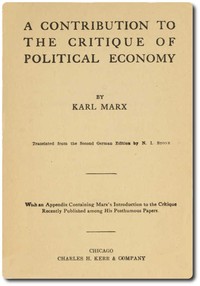
A CONTRIBUTION TO THE CRITIQUE OF POLITICAL ECONOMY
BY KARL MARX
Translated from the Second German Edition by N. I. Stone
With an Appendix Containing Marx’s Introduction to the Critique Recently Published among His Posthumous Papers
CHICAGO CHARLES H. KERR & COMPANY
Copyright, 1904 By the International Library Publishing Co.
TRANSLATOR’S PREFACE.
The present translation has been made from the second edition of the “Zur Kritik der Politischen Oekonomie,” published by Karl Kautsky in 1897 with slight changes from the original edition of 1859; changes that had been indicated by Marx on the margins of his own copy of the book.
As will be seen from the author’s preface, the work was originally issued as the first instalment of a complete treatise of political economy. As he went on with his work, however, Marx modified his plans and eight years after the appearance of the “Zur Kritik” he published the first volume of his Capital, whose scope was intended to cover the entire field of political economy.
The plan to which Marx alludes in the preface to the present work was thus abandoned in its formal aspects, but not in substance. The subject matter treated here was reproduced or rather “summarized,” as Marx himself puts it, in Capital. But that was done in so far as was necessary to secure continuity of treatment. On the other hand, many important matters are treated here more thoroughly than in Capital, especially the part devoted to the discussion of money. This, as well as the chapters on the history of the theories of value and of money, which do not appear in Capital, make “Zur Kritik” a work practically complete in itself.
The recent silver agitation in this country shows how timely and useful this work still is, though written nearly half a century ago. That a great part of the working-men employed in the cities were not carried away by the Democratic-Populist agitation in 1896 and 1900 is probably due in a greater measure than is commonly realized to the direct and indirect influence of Marx, whose economic teachings guided the socialists in their counter agitation. And since the conditions which once gave rise to a demand for an inflated currency have by no means disappeared beyond a possibility of return, this book has a wide field before it, outside of the library of the college and of the student of economics, which the author’s name and prestige with the working class insures for it.
There is another reason, if any need be given why this book should have been translated into English. Marx’s preface to the present work contains the classic formulation of his historico-philosophic theory known as the Materialistic Interpretation of History. This theory, which until recently was entertained almost exclusively by socialist writers and was hardly heard of outside of socialist circles in English speaking countries, is at last receiving not only due recognition but sympathetic appreciation at the hands of men of science.[1] It is rather a significant coincidence that the work which for the first time clearly formulated the law governing social evolution should have seen the light of day in the same year in which Darwin gave to the world his theory of organic evolution. And as the latter had to fight its way to recognition in the teeth of religious prejudices, so has the recognition of the former been retarded by even more powerful social and political prejudices.
The Introduction to the Critique of Political Economy which is added as a supplement to this book is for the first time published in book form in any language. It was written by Marx in 1857, but for reasons explained by him in the preface was not published and in fact was never finished by him, since according to his changed plans it would have fitted more into the last volume of Capital which was to contain a history of political economy. The introduction has been published but lately in the form of a magazine article by Karl Kautsky, editor of the Neue Zeit and literary executor of Karl Marx.
A few explanations are here in order with reference to the work of translation. No one is more keenly alive to the shortcomings of the English rendering of the original than the translator himself. While fully conscious that the translation might be greatly improved, he has at times deliberately sacrificed literary finish to closeness to the original. It will be found that many passages have been rendered more clear and concise in Capital in which, according to Marx’s own statement in the preface to that work, they were much simplified and popularized. The Hegelian phraseology is more in evidence in the present work rendering translation a more difficult task. Yet for that very reason it seemed particularly desirable to give to English speaking readers as close a version of the original as was possible. In the few cases where certain passages from this work were reproduced by Marx in Capital, the translation of the latter by Moore and Aveling was freely drawn upon with slight modifications here and there.
About the only liberty taken with Marx’s terminology has been in the case of the word “bürgerlich.” Marx speaks here of “bürgerliche Produktion” and “bürgerlicher Reichthum” and “bürgerliche Arbeit” where eight years later he used in corresponding passages in Capital the word “kapitalistische.” As the English speaking reader is more accustomed to hear of the “capitalist” system of production than of the “bourgeois” system of production, etc., the translator considered Marx’s own change of this term within a few years from the publication of “Zur Kritik” a sufficient justification for rendering the word “bürgerlich” into “capitalistic” wherever it seemed more likely to carry the meaning home to the reader.
In view of the fact that the work is likely to be read in wide circles it was thought desirable to translate the numerous quotations from Italian, Greek, Latin and French writers, the translation being given side by side with the original quotation. All English citations given by Marx in German have been restored from the original sources, which necessitated the use of four libraries, the Astor and the Columbia University libraries in New York, the Congressional Library in Washington, and the private library of Professor Seligman to whose kindness the translator is indebted for the permission to use rare works of the seventeenth century quoted by Marx. Several of Marx’s references to the pages of the books quoted by him have been found to be wrong and therefore differ here from those given in the original. In two or three cases where the original English citations could not be found they were retranslated from German with the quotation marks omitted.
This statement would be incomplete if the translator failed to mention the helpful participation in this work by his wife whose share in the translation is equal to his own.
New York, October, 1903.
AUTHOR’S PREFACE.
I consider the system of bourgeois economy in the following order: Capital, landed property, wage labor; state, foreign trade, world market. Under the first three heads I examine the conditions of the economic existence of the three great classes, which make up modern bourgeois society; the connection of the three remaining heads is self evident. The first part of the first book, treating of capital, consists of the following chapters: 1. Commodity; 2. Money, or simple circulation; 3. Capital in general. The first two chapters form the contents of the present work. The entire material lies before me in the form of monographs, written at long intervals not for publication, but for the purpose of clearing up those questions to myself, and their systematic elaboration on the plan outlined above will depend upon circumstances.
I omit a general introduction which I had prepared, as on second thought any anticipation of results that are still to be proven, seemed to me objectionable, and the reader who wishes to follow me at all, must make up his mind to pass from the special to the general. On the other hand, some remarks as to the course of my own politico-economic studies may be in place here.
The subject of my professional studies was jurisprudence, which I pursued, however, in connection with and as secondary to the studies of philosophy and history. In 1842-43, as editor of the “Rheinische Zeitung,” I found myself embarrassed at first when I had to take part in discussions concerning so-called material interests. The proceedings of the Rhine Diet in connection with forest thefts and the extreme subdivision of landed property; the official controversy about the condition of the Mosel peasants into which Herr von Schaper, at that time president of the Rhine Province, entered with the “Rheinische Zeitung;” finally, the debates on free trade and protection, gave me the first impulse to take up the study of economic questions. At the same time a weak, quasi-philosophic echo of French socialism and communism made itself heard in the “Rheinische Zeitung” in those days when the good intentions “to go ahead” greatly outweighed knowledge of facts. I declared myself against such botching, but had to admit at once in a controversy with the “Allgemeine Augsburger Zeitung” that my previous studies did not allow me to hazard an independent judgment as to the merits of the French schools. When, therefore, the publishers of the “Rheinische Zeitung” conceived the illusion that by a less aggressive policy the paper could be saved from the death sentence pronounced upon it, I was glad to grasp that opportunity to retire to my study room from public life.