TRANSCRIBER’S NOTES:
—Obvious print and punctuation errors were corrected.
—Whereas adequate characters are not available, superscript has been rendered as a^b and a^{bc}.
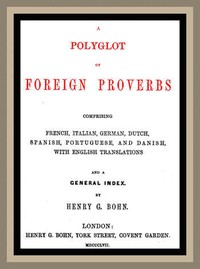
A POLYGLOT OF FOREIGN PROVERBS
COMPRISING
FRENCH, ITALIAN, GERMAN, DUTCH, SPANISH, PORTUGUESE, AND DANISH, WITH ENGLISH TRANSLATIONS
AND A GENERAL INDEX.
BY HENRY G. BOHN.
LONDON: HENRY G. BOHN, YORK STREET, COVENT GARDEN. MDCCCLVII.
PREFACE.
WHILE engaged in editing my Handbook of English Proverbs, it occurred to me that a Collection of Foreign Proverbs, arranged in monographs, and brought as far as possible into juxta-position by a General Index, would be an interesting volume, as well to the ordinary reader as to the linguist. And it happened that more than one public writer, in reviewing my Handbook, suggested nearly the same idea, which determined me to realise it as speedily as other engagements would permit.
After a lapse of more than two years, and much patient labour, during intervals of business or hours snatched from repose, I am enabled to present my gleanings to the public, and hope they will not be found deficient of grain.
It will be seen that many of the proverbs are quite new to the English reader, and that others, hitherto supposed to be essentially, if not exclusively, English, are common to several other languages.
A task so various and complicated could not well be executed without aid, nor do I pretend to be master of all the languages included. Accordingly, I sought the assistance of competent scholars, and have great pleasure in here proclaiming my acknowledgments to them. After the groundwork of the volume had been laid by selections from a great variety of sources, an operation in which Mr. W. K. Kelly was my principal collaborateur, I was aided in correcting the Italian by Signor Pistrucci, the Spanish by Señor Yrazoqui and the Chevalier Francisque Michel, the Portuguese by Senhôr Guerra, the Danish by Miss Rowan, and the Dutch by Mr. John van Baalen, of Rotterdam. It seemed to me advisable, to secure all possible accuracy, that each foreign language should be read over by a native of the country.
For the English translations (excepting those from the Danish) I am myself mainly responsible, as, where those already existing did not satisfy me, I generally substituted others. I have, however, been very forbearing towards some pleasant bits of doggerel and alliteration found in early volumes, and have occasionally indulged in similar playfulness of my own. One so deeply immersed in Proverb-lore may, perhaps, be forgiven for having imbibed such a tendency.
In the Index, a single line is often made to represent a whole group, although the several translations may not be exactly the same. That adopted as the key, being the last thought, ought to be the best. The running lines at the top indicate the pages of each of the several languages, so that by a comparison of them with the figures of reference below, it will be easy to see what monograph a proverb belongs to, without actually turning to the page.
HENRY G. BOHN.
August 30, 1857.
CONTENTS.
PAGE
FRENCH PROVERBS 1- 64 ITALIAN 65-132 GERMAN 133-192 SPANISH 193-262 PORTUGUESE 263-295 DUTCH 296-345 DANISH 346-403 ENGLISH INDEX 405-579
FRENCH PROVERBS.
A.
A barbe de fol apprend-on à raire. On a fool’s beard the barber learns to shave.
A beau demandeur, beau refuseur. Handsomely asked, handsomely refused.
A beau jeu beau retour. One good turn deserves another.
A beau mentir qui vient de loin. He may lie boldly who comes from afar.
A bon appétit il ne faut point de sauce. Hunger is the best sauce.
A bon chat bon rat. To a good cat a good rat.
A bon cheval point d’éperon. Spur not a willing horse.
A bon chien il ne vient jamais un bon os. A good dog never gets a good bone.
Abondance de biens ne nuit pas. Store is no sore.
A bon entendeur demi-mot. A word to the wise.
A bon pêcheur échappe anguille. An eel escapes from a good fisherman.
A bon vin point d’enseigne. Good wine needs no sign.
A brebis tondue Dieu mesure le vent. God tempers the wind to the shorn lamb.
Absent le chat, les souris dansent. When the cat’s away the mice will play.
Absent n’est point sans coulpe ni présent sans excuse. Absent, none without blame; present, none without excuse.
A carême-prenant chacun a besoin de sa poële. At shrove-tide every one has need of his frying-pan.
A celui qui a son pâté au four on peut donner de son gâteau. To one who has a pie in the oven you may give a bit of your cake.
A chacun son fardeau pèse. Every one feels his own burden heavy.
A chair de loup sauce de chien. For wolf’s flesh dog sauce.
A chaque fou plaît sa marotte. Every fool likes his bauble.
A chaque jour suffit sa peine. Sufficient for the day is the evil thereof.
A chaque saint son cierge. To every saint his candle.
A chemin battu ne croît point d’herbe. No grass grows on a beaten road.
Acheter chat en poche. To buy a cat in a poke.
A cheval donné, il ne faut point regarder à la bouche. Look not a gift horse in the mouth.
A chose faite conseil pris. When a thing is done advice comes too late.
A confesseurs, médecins, avocats, la vérité ne cèle de ton cas. _From confessors, doctors, and lawyers, do not conceal the truth of your case._
Adieu paniers, vendanges sont faites. Farewell baskets, the vintage is ended.
A dur âne dur aiguillon. For a stubborn ass a hard goad.
A femme avare galant escroc. A covetous woman deserves a swindling gallant.
A force de mal aller tout ira bien. By dint of going wrong all will come right.
A fripon fripon et demi. To a rogue a rogue and a half.
A goupil endormi rien ne lui chet en gueule. Nothing falls into the mouth of a sleeping fox.
A homme hardi fortune tend la main. To a bold man fortune holds out her hand.
Aide-toi, le ciel t’aidera. Help thyself and heaven will help thee.
Aime-moi un peu, mais continue. Love me a little, but love me long.
Aimer et savoir n’ont même manière. To love and to be wise are two different things.
Ainsi dit le renard des mûres, quand il n’en peut avoir: elles ne sont point bonnes. The fox says of the mulberries when he cannot get at them: they are not good at all.
Aisé à dire est difficile à faire. Easy to say is hard to do.
A la chandelle la chèvre semble demoiselle. By candle-light a goat looks like a lady.
A la fin saura-t-on qui a mangé le lard. In the end it will be known who ate the bacon.
A la guerre comme à la guerre. At the wars as they do at the wars.
A l’amour et au feu on s’habitue. One grows used to love and to fire.
A la presse vont les fous. Fools go in throngs.
A la queue gît le venin. In the tail lies the venom.
A l’aventure on met les ”oe]ufs couver. Eggs are put to hatch on chance.
A laver la tête d’un âne on ne perd que le temps et la lessive. To wash an ass’s head is but loss of time and soap. (To reprove a fool is but lost labour.)
A l’impossible nul n’est tenu. No one is bound to do impossibilities.
Aller aux mûres sans crochet. To go mulberry-gathering without a crook.
Aller en vendanges sans panier. To go to the vintage without baskets.
A l’”oe]il malade la lumière nuit. Light is bad for sore eyes.
A l’”oe]uvre on connaît l’ouvrier. The workman is known by his work.
A l’ongle on connaît le lion. You may know the lion by his claw.
A longue corde tire qui d’autrui mort désire. He pulls at a long rope who desires another’s death.
A mal enfourner on fait les pains cornus. Loaves put awry into the oven come out crooked.
A mal pasteur le loup chie laine. An easy shepherd makes the wolf void wool.
A marmite qui bout mouche ne s’attaque. Flies will not light on a boiling pot.
A mauvais chien l’on ne peut montrer le loup. There’s no showing the wolf to a bad dog.
A méchant chien court lien. A vicious dog must be tied short.
A merle soûl cerises sont amères. Cherries are bitter to the glutted blackbird.
Ami de table est variable. A table friend is changeable.
A morceau restif éperon de vin. A restive morsel needs a spur of wine.
Amour de grands, ombre de buisson qui passe bientôt. The friendship of great men is like the shadow of a bush, soon gone.
Amour et seigneurie ne veulent point de compagnie. Love and lordship like no fellowship.
Amour fait moult, argent fait tout. Love does much, money everything.
Amour soumet tout hormis c”oe]ur de félon. Love subdues everything except the recreant’s heart.
Amour, toux, fumée, et argent, ne se peuvent cacher longuement. Love, a cough, smoke, and money, cannot long be hid.
Amour, toux, et fumée, en secret ne font demeurée. Love, a cough, and smoke will not remain secret.
Ane piqué convient qu’il trotte. A goaded ass must trot.
A nouveaux seigneurs nouvelles lois. New lords, new laws.
A nul ne peut être ami qui de soi-même est ennemi. He cannot be a friend to any one who is his own enemy.
A paroles lourdes oreilles sourdes. To rude words deaf ears.
A père avare enfant prodigue. A miserly father makes a prodigal son.
A petite achoison le loup prend le mouton. Upon a slight pretext the wolf takes the sheep.
A petite fontaine boit-on à son aise. At a little fountain one drinks at one’s ease.