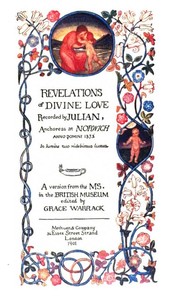
REVELATIONS of DIVINE LOVE Recorded by JULIAN, Anchoress at NORWICH ANNO DOMINI 1373
In lumine tuo videbimus lumen
A version from the MS. in the BRITISH MUSEUM edited by GRACE WARRACK
Methuen & Company 36 Essex Street Strand London 1901
DOMINI, REFUGIUM FACTUS ES NOBIS, A GENERATIONE IN GENERATIONEM. RESPICE IN SERVOS TUOS, ET IN OPERA TUA: ET DIRIGE FILIOS EORUM. ET SIT SPLENDOR DOMINI DEI NOSTRI SUPER NOS, ET OPERA MANUUM NOSTRARUM DIRIGE SUPER NOS: ET OPUS MANUUM NOSTRARUM DIRIGE.
"Truth seeth God, and Wisdom beholdeth God, and of these two cometh the third: that is a holy, marvelling delight in God; which is Love."
CONTENTS
PAGE I. NOTES ON MANUSCRIPTS AND EDITIONS OF THIS BOOK. xi
II. NOTE AS TO TWO JULIANS. xv
III. INTRODUCTION:-- Part I. The Lady Julian. xvii Part II. The Manner of the Book. xxxiii Part III. The Theme of the Book. lv
IV. "REVELATIONS OF DIVINE LOVE":-- (editorial account)
i. A List of Contents, called "A Particular of the Chapters". 1
ii.-iii. Autobiographical. 3
iv.-ix. The First Revelation: The Trinity is shewn, through the Suffering of Christ, as Goodness, or Love all-working. 8
x. The Second Revelation: Man's Sight of God's Love is but partial because of sin's darkness. 21
xi. The Third Revelation: All Being is Being of God and is good: Sin is no Being. 26
xii. The Fourth Revelation: The stain of sin through lacking of human love is cleared away by the Death of Christ in His Love. 29
xiii. The Fifth Revelation: By Love's Sacrifice, in Christ, the evil suffered, for Love's Increase, to rise, is overcome for ever. 30
xiv. The Sixth Revelation: The travail of Man against evil on earth is a glory accepted by Love in Heaven. 33
xv. The Seventh Revelation: It is of God's Will, for our learning, that on earth we change between joy of light and pain of darkness. 34
xvi.-xxi. The Eighth Revelation: Of the oneness of God and Man in the Passion of Christ, through Compassion of the Creature with Christ and of Christ with the Creature. All compassion in men is Christ in men. 36
xxii.-xxiii. The Ninth Revelation: Of the worshipful entering of Man's soul into the Joy of Love Divine in the Passion. 46
xxiv. The Tenth Revelation: Of the thankful entering of the soul into the Peace of the Endless Love opened up for Man in the time of the Passion. 51
xxv. The Eleventh Revelation: Of Christ's Raising, Fulfilling Love to the souls of men, as beheld in the love between Him and His Mother. 52
xxvi. The Twelfth Revelation: All that the soul lives by and loves is God, through Christ. 54
xxvii.-xl. The Thirteenth Revelation: Man's finite love was suffered by Infinite Love to fail, that falling thus through sin into pain and death of darkness, the creature therein might more deeply know his need and more highly know, in its succouring strength, the Creator's Love, as the Saviour's; that so being raised, and for ever held clinging to that through the grace of the Holy Ghost, he might rise to fuller and higher and endless oneness with God. 55
xli.-xliii. The Fourteenth Revelation: Beginning on earth, Prayer makes the soul one with God. 84
xliv.-lxiii. Regarding these Revelations and the Christian Life of Love's travail on earth against sin. 93
lxiv.-lxv. The Fifteenth Revelation (Closing): Of Love's Fulfilment in Heaven. 159
lxvi. Autobiographical: The fall through frailty of nature, by self-regarding, into doubt of the Shewing of Love; the rescue by mercy; the assaying of faith and the overcoming by grace. 164
lxvii.-lxviii. The Sixteenth Revelation (Confirming): The Indwelling of God In the Soul, now and for ever. "Thou shalt not be overcome." 167
lxix. Autobiographical: The second assaying of faith, through the horror of spiritual darkness; the overcoming by virtue of the Passion of Christ, with help from the Common Belief of the Christian Fellowship. 170
lxx.-lxxxv. The Life of Faith is kept by Charity, led on by Hope 172
lxxvi. The Meaning of the Whole. Of learning more on earth and In Heaven of the One thing taught in the Revelation: the Endless Love; in Which Life is everlasting. 201
V. POSTSCRIPT BY AN EARLY TRANSCRIBER OF THE MANUSCRIPT. 204
VI. GLOSSARY. 205
The Title-page is from a design by Phoebe Anna Traquair.
NOTES ON MANUSCRIPTS AND EDITIONS
This English book exists in two Manuscripts: No. 30 of the Bibliothèque Nationale, Paris (Bibliotheca Bigotiana, 388), and No. 2499 Sloane, in the British Museum.
The Paris Manuscript is of the Sixteenth Century, the Sloane is in a Seventeenth Century handwriting; the English of the Fourteenth Century seems to be on the whole well preserved in both, especially perhaps in the later Manuscript, which must have been copied from one of mixed East Anglian and northern dialects. This manuscript has no title-page, and nothing is known as to its history. Delisle's catalogue of the Biblioth. Bigot. (1877) gives no particulars as to the acquisition of No. 388. The two versions may be compared in these sentences:--
Chap. II., Paris MS.: "This revelation was made to a Symple creature unlettyrde leving in deadly flesh the yer of our Lord a thousande and thre hundered and lxxiii the xiii Daie of May."
Sloane: "These Revelations were shewed to a simple creature that cowde no letter the yeere of our Lord 1373 the xiij day of may."
Chap. LI., Paris MS.: "The colour of his face was feyer brown whygt with full semely countenaunce. his eyen were blakke most feyer and semely shewyng full of lovely pytte and within hym an heyward long and brode all full of endlesse hevynlynes. And the lovely lokyng that he lokyd on his servant contynually. And namely in his fallyng ÷ me thought it myght melt oure hartys for love. and brek them on twoo for Joy."
Sloane: "The color of his face was faire browne, with ful semely features, his eyen were blak most faire and semely shewand ful of lovely pety and within him an heyward long and brode all full of endles hevyns, and the lovely lokeing that he loked upon his servant continuly and namely in his fallyng me thowte it myte molten our herts for love & bresten hem on to for joy."
The Sloane MS. does not mention the writer of the book, but the copyist of the Paris version has, after the Deo Gratias with which it ends, added or transcribed these words: Explicit liber Revelationem Julyane anatorite [sic] Norwyche cujus anime propicietur Deus.
Blomefield, in his History of Norfolk (iv. p. 81), speaks of "an old vellum Manuscript, 36 pages of which contained an account of the visions, etc.," of the Lady Julian, anchoress at St. Julian's, Norwich, and quotes the title written by a contemporary: "Here es a Vision shewed by the godenes of God to a devoute Woman: and her name is Julian, that is recluse at Noryche, and yett is on life, Anno Domini mccccxlii. In the whilke Vision er fulle many comfortabyll words, and greatly styrrande to alle they that desyres to be Crystes Looverse"--greatly stirring to all that desire to be lovers of Christ. This Manuscript, possibly containing the writing of Julian herself, was in the possession of the Rev. Francis Peck (1692-1743). The original MSS. of that antiquarian writer went to Sir Thomas Cave, and ultimately to the British Museum, but his general library was sold in 1758 to Mr T. Payne (of Payne & Foss), bookseller, Strand, and this old Manuscript of the "Revelations," which has been sought for in vain in the catalogues of public collections, may perhaps have been bought and sold by him.[1] It may be extant in some private library.
Tersteegen, who, in his Auserlesene Beschreibungen Heiliger Seelen, gives a long extract from Julian's book (vol. iii. p. 252, 3rd ed. 1784), mentions in his preface that he had seen "in the Library of the late Poiret" an old Manuscript of these Revelations. Pierre Poiret, author of several works on mystical theology, died in 1719 near Leyden, but the Manuscript has not found its way to the University there.
Poiret himself refers thus to Julian and her book in his Catalogus Auctorum Mysticorum, giving to her name the asterisk denoting greatness: "Julianae Matris Anachoretae, Revelationes de Amore Dei. Anglice. Theodidactae, profundae, ecstaticae." (Theologiae Pacificae itemque Mysticae, p. 336. Amsterdam, 1702.)
The earliest printed edition of Julian's book was prepared by the Benedictine Serenus de Cressy, and published in 1670 by permission of his ecclesiastical Superior, the Abbot of Lambspring, under the title of Sixteen Revelations of Divine Love. It agrees with the Manuscript now in Paris, but the readings that differ from the Sloane Manuscript are very few and are quite unimportant. This version of de Cressy's is in Seventeenth Century English with some archaic words, which are explained on the side margins; it was re-printed in 1843. A modernised version taken from the Sloane MS. was published, with a preface, by Henry Collins in 1877 (T. Richardson & Sons).