------------------------------------------------------------------------
Transcriber’s Note:
This version of the text cannot represent certain typographical effects. Italics are delimited with the ‘_’ character as italic. The text also affected the now obsolete ‘long s’ (ſ). All of been replaced with the modern ‘s’.
Each article is marked with a sidenote indicating the year a Pope assumed the office. These notes are underscored with a large horizontal brace, which is not reproduced here.
Marginal ‘sidenotes’ are marked as ‘[Sidenote: text]’ They appear either preceding a paragraph, or, when they annotate text within a paragraph, approximately where they occur in the original, usually on a sentence break.
Minor errors, attributable to the printer, have been corrected. Please see the transcriber’s note at the end of this text for details regarding the handling of any textual issues encountered during its preparation.
The original text does not include a Table of Contents. The following has been constructed for ease of navigation
St. PETER LINUS, First Bishop of Rome, CE 66. CLETUS or ANACLETUS Second Bishop of Rome, CE 78. CLEMENT, Third Bishop of Rome, CE 91. EVARISTUS Fourth Bishop of Rome, CE 100. ALEXANDER, Fifth Bishop of Rome, CE 109. SIXTUS, Fourth Bishop of Rome, CE 119. TELESPHORUS, Seventh Bishop of Rome, CE 128. HYGINUS, Eighth Bishop of Rome, CE 139. PIUS, Ninth Bishop of Rome, CE 142. ANICETUS, Tenth Bishop of Rome, CE 157. SOTER, Eleventh Bishop of Rome, CE 168. ELEUTHERIUS, Twelfth Bishop of Rome, CE 176. VICTOR, Thirteenth Bishop of Rome, CE 192. ZEPHYRINUS, Fourteenth Bishop of Rome, CE 201. CALLISTUS, Fifteenth Bishop of Rome, CE 219. URBANUS, Sixteenth Bishop of Rome, CE 223. PONTIANUS, Seventeenth Bishop of Rome, CE 230. ANTERUS, Eighteenth Bishop of Rome, CE 235. FABIANUS, Nineteenth Bishop of Rome, CE 236. CORNELIUS, Twentieth Bishop of Rome, CE 251. LUCIUS, Twenty-first Bishop of Rome, CE 252. STEPHEN, Twenty-second Bishop of Rome, CE 253. SIXTUS II. Twenty-third Bishop of Rome, CE 257. DIONYSIUS, Twenty-fourth Bishop of Rome, CE 258. FELIX, Twenty-fifth Bishop of Rome, CE 269. EUTYCHIANUS, Twenty-sixth Bishop of Rome, CE 275. CAIUS, Twenty-seventh Bishop of Rome, CE 283. MARCELLINUS, Twenty-eighth Bishop of Rome, CE 296. MARCELLUS, Twenty-ninth Bishop of Rome, CE 308. EUSEBIUS, Thirtieth Bishop of Rome, CE 310. MELCHIADES, Thirty-first Bishop of Rome, CE 311. SYLVESTER, Thirty-second Bishop of Rome, CE 314. MARK, Thirty-third Bishop of Rome, CE 336. JULIUS, Thirty-fourth Bishop of Rome, CE 337. LIBERIUS, Thirty-fifth Bishop of Rome, CE 352. DAMASUS, Thirty-sixth Bishop of Rome, CE 366. SYRICIUS, Thirty-seventh BISHOP of Rome, CE 384. ANASTASIUS, Thirty-eighth Bishop of Rome, CE 398. INNOCENT, Thirty-ninth Bishop of Rome, CE 402. ZOSIMUS, Fortieth Bishop of Rome, CE 417. BONIFACE, Forty-first Bishop of Rome, CE 419. CELESTINE, Forty-second Bishop of Rome, CE 422.
-----------------------------------------------------------------------
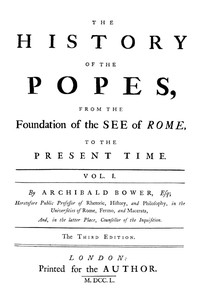
THE HISTORY OF THE POPES,
FROM THE Foundation of the SEE of ROME,
TO THE
PRESENT TIME.
------------------------------------------------------------------------
VOL. I.
------------------------------------------------------------------------
By ARCHIBALD BOWER, Esq;
Heretofore Public Professor of Rhetoric, History, and Philosophy, _in the Universities of_ Rome, Fermo, and Macerata,
And, in the latter Place, Counsellor of the Inquisition.
------------------------------------------------------------------------
The THIRD EDITION.
LONDON: Printed for the AUTHOR.
---
M. DCC. L.
TO THE
KING
SIR,
It is not only as having the Happiness to be Your subject, that I beg Your permission to lay this Book at Your feet. In whatever part of the world I had been born, or had resided, I should have desired to present it to Your Majesty, as the Great Protector of the Reformed Religion, and worthily filling that Throne, which, above any in Europe, is the chief Bulwark against the Papal Power, and all its pernicious attendants. The wonderful rise, and monstrous growth of that Power, almost to the ruin of all true Religion, and all the Civil rights of mankind, will be delineated in the course of this Work, which I flatter myself may be of some Use to the Protestant Cause. For, next to the light of the Gospel, there is nothing that Popery has more to fear, than that of historical Truth: It is a test which the pretensions and doctrines of Rome can never abide; and therefore she has used her utmost endeavours, not only to lock up the Gospel from the eyes of the Laity, and prefer her own Comments, Decrees, and Traditions, to the authority of the Scriptures, but to corrupt, disguise, and falsify History, in which necessary business her ablest pens have been employed. To take off those disguises, and discover those falsehoods, is consequently a task becoming the zeal of a good Protestant; and my intention at least, though not my performance encourages me to hope for Your Majesty’s Gracious Protection.
In the latter part of this History I shall have often the pleasure to shew, how great an Instrument under GOD the Power and Strength of this kingdom has been, to maintain and support the Reformation all over Europe. But I must also shew with concern, that from the death of our wise Queen Elizabeth, the Princes of the House of Stuart, instead of pursuing that glorious Plan, which she had traced out, were either remiss in the cause, or wholly forsook it; so that had not the Revolution providentially happened, and in consequence of it, the House of Brunswick been called to the Throne of these kingdoms, the Reformed Religion would, in all probability, have not only been lost in Great Britain, or at least under a fate of severe persecution, but would have been in great danger every-where else, from such a change in the Balance of Power as that event must have produced. The support of Your Royal Family is therefore most necessary, even upon motives of self-preservation, to every Protestant both here and abroad. May a due sense of that important connection between Your safety and Theirs, be always kept alive in their minds. May our Holy Religion continue to flourish under Your Majesty’s Care, and that of Your Royal Posterity, to the latest times. May neither the open attacks, nor secret machinations of Rome prevail against it. And may it produce all the Fruits that ought to spring from it, the truly-christian spirit of Toleration, universal charity, good morals, good learning, freedom of thought, and candour of mind. I need add no other wishes or prayers to these: They comprehend all happiness to Your Majesty, to Your Royal Family, and to my Country; and they come from the heart of,
Sir, Your Majesty’s Most Loyal, Most Faithful, And most devoted Subject,
ARCHIBALD BOWER.
------------------------------------------------------------------------ ------------------------------------------------------------------------
THE PREFACE
The Work, which I now offer to the Public, I undertook some years since at Rome, and brought it down to the Pontificate of Victor, that is, to the close of the Second Century. As I was then a most zealous champion for the Pope’s Supremacy, which was held as an article of Faith by the body I belonged to, my chief design, when I engaged in such a work, was, to ascertain that Supremacy, by shewing, century by century, that, from the Apostles times to the present, it had ever been acknowleged by the Catholic Church. But alas! I soon perceived, that I had undertaken more than it was in my power to perform. Nay, while, in order to support and maintain this cause, I examined, with particular attention, the writings of the Apostles, and of the many pious and learned men who had flourished in the three first centuries of the church, I was so far from finding any thing that seemed the least to countenance such a doctrine, that, on the contrary, it appeared evident, beyond all dispute, that, during the above-mentioned period of time, it had been utterly unknown to the Christian world. In spite then of my endeavours to the contrary, Reason getting the better of the strongest prejudices, I began to look upon the Pope’s Supremacy, not only as a prerogative quite chimerical, but as the most impudent attempt that had ever been made: I say, in spite of my endeavours to the contrary; for I was very unwilling to give up a point, upon which I had been taught by Bellarmine, that _the whole of Christianity depended_[1]; especially in a country, where a man cannot help being afraid even of his own thoughts, since, upon the least suspicion of his only calling in question any of the received opinions, he may depend upon his being soon convinced by more cogent arguments, than any in Mood and Figure. But great is the power of truth; and at last it prevailed: I became a proselyte to the opinion which I had proposed to confute; and sincerely abjured, in my mind, that which I had ignorantly undertaken to defend.