Transcriber’s Note:
This version of the text cannot represent certain typographical effects. Italics are delimited with the ‘_’ character (e.g. some italic text). For other changes see the Transcriber’s Note at the end of the text.
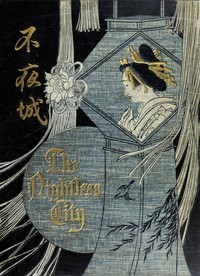
THE NIGHTLESS CITY
不夜城
OR THE “HISTORY OF THE YOSHIWARA YŪKWAKU”
By J. E. DE BECKER
Twenty Years a Resident of Japan
“Virtuous men have said, both in poetry and classic works, that houses of debauch, for women of pleasure and for street-walkers, are the worm-eaten spots of cities and towns. But these are necessary evils, and if they be forcibly abolished, men of unrighteous principles will become like ravelled thread.”
73rd section of the “Legacy of Ieyasu,” (the first Tokugawa Shōgun.)
With Numerous Illustrations
Third Edition Revised
Yokohama Shanghai Bremen
MAX NÖSSLER & Co.
London
PROBSTHAIN & Co.
14 Bury Street, W.C.
Copyright,
BY THE AUTHOR.
All rights reserved.
PRINTED BY THE BOX OF CURIOS PRINTING AND PUBLISHING CO., YOKOHAMA. JAPAN.
Contents
PAGE.
History of the Yoshiwara Yūkwaku 1
Nihon-dzutsumi (The Dyke of Japan) 15
Mi-kaeri Yanagi (Gazing back Willow-tree) 16
Yoshiwara Jinja (Yoshiwara Shrine) 17
The “Aisome-zakura” (Cherry-tree of First Meeting) 18
The “Koma-tsunagi-matsu” (Colt tethering Pine-tree) 18
The “Ryo-jin no Ido” (Traveller’s Well) 18
Government Edict-board and Regulations at the Ōmon (Great Gate) 18
The Present Ōmon 19
Of the Reasons why going to the Yoshiwara was called “Chō ye Yuku” 21
Classes of Brothels 21
Hikite-jaya (“Introducing Tea-houses”) 28
The Jū-hachi-ken-jaya (Eighteen Tea-houses) 41
The “Amigasa-jaya” (Braided Hat Tea-houses) 42
The “Kujaku Nagaya” 42
The “Kembansho” 43
Classes of Prostitutes 44
“Kamuro” (Young Female Pages) 52
Shinzō 55
Yarite (Female Managers) 59
The “Kutsuwa” 62
The “Wakaimono” (Male Servants) 63
Hōkan and Geisha 67
The Europeanization of the Yoshiwara and the Introduction of Loochooan Courtesans 84
Zegen (Procurers) 85
The Dress of Courtesans 94
Coiffures of the Yūjo 99
Rooms of the Yūjo 104
Tsumi-yagu no koto 108
Sōbana (“All round tips”) 112
Shokwai (First Meeting) and Mi-tate (Selection of Women) 112
I-tsuzuke no koto 118
O cha wo hiku to iū koto 118
Shiki-zome no soba-burumai no koto 119
Shashin-mitate-chō (Photograph Albums for Facilitating the Selection of Women) 121
Signs and Cyphers Showing the fees of Courtesans 123
System of Book-keeping in the Yoshiwara 124
Brothel Advertisements 130
Ageya no sashi-gami (Summons to the “Ageya”) 134
Yoshiwara Dialect 136
Magic Charms of the Yoshiwara 140
Yoshiwara “Pot-pourri” 156
Dai-ya no koto (Cook-houses of the Yoshiwara) 158
Famous Things of the Yoshiwara 160
Peddlers, Hawkers, and Beggars 160
The Examination of Licensed Women at the Hospital for Venereal Complaints 163
Results of Medical Inspection 166
Mu-sen Yū-kyō (Going on a “Spree” without having any money to pay for it) 167
Yoshiwara-gayoi no Jinrikisha. (The Jinrikisha Traffic of the Yoshiwara) 170
Sanya-uma da-chin-dzuké (The Cost of Hiring Horses to and from the Yoshiwara) 174
Byō-chū oyobi In-shoku no koto (Of the Sickness of Prostitutes and of Their Meals) 176
Hiké no koto (Closing Hours in the Yoshiwara) 177
Kōchō no koto (The Next Morning) 177
Hiru-jimai Yo-jimai no koto (The Day and Night Engagements of Courtesans) 177
Raku-seki no koto (The Removal of Names from the Register of the Yoshiwara) 178
Gwaishutsu oyobi tōbō (Exit and Flight from the Yoshiwara) 180
Yūjo byō-shi oyobi jō-shi no koto (Of the Death and Double-suicide of Courtesans) 183
Shin-Yoshiwara no Bodaiji (The Cemetery of the Shin-Yoshiwara) 186
Karitaku no koto (The Temporary Prostitute Quarter) 186
Dōchū no koto oyobi tsuki-dashi no koto (The Processions of Yūjo and the First Appearance of “Recruits” in the Yoshiwara) 191
Yo-misé “Suga-gaki” no koto (The Night Exhibition and the Suga-gaki) 201
Daijin-mai no koto (Dancing of Millionaires) 206
Daikoku-mai no koto (Daikoku-mai Dancing) 210
Introductory Songs of the “Daikoku-mai” 211
Dote-bushi no koto oyobi Hayari-uta (Dote-bushi (Songs) and Popular Songs) 214
Annals of a Year 217
Naka-no-chō no Hana-ue (Flower-planting in the Naka-no-chō) 229
Tōrō no koto (Lanterns) 232
Niwaka Dancing 235
Tori-no-machi 245
Yoshiwara Nana-fushigi (The Seven Mysteries of the Yoshiwara) 246
Yoshiwara no Kyō-ka (Comic Poetry) 247
Yoshiwara Kwai-rok-ki (Chronology of Fire Disasters in the Yoshiwara) 248
Furi-sodé Kwaji (The Great Fire of Meireki) 254
Mei-gi ryaku-den (Brief Sketches of the Lives of Famous Courtesans) 261
Takao 261
Hana-ōgi 264
Tamakoto 267
Katsuyama 268
Segawa 270
Usugumo 271
Ōsumi 274
Ko-murasaki 275
Kaoru 278
Kokonoye 281
Kinokuni-ya Bunzaemon 282
The Laws Relating to the Control of Prostitution 288
Forms of Contracts between Brothels and Courtesans 303
The Medical Aspect 311
Result of Medical Inspection in the Shin-Yoshiwara, 1898 315
Result of Medical Inspection in the Shin-Yoshiwara. January to April 1899 315
Statistics re Social Evil in Japan in 1898 316
Pros and Cons 316
Correspondence from the “Japan Times” 316
Notes on “Jigoku” or Illicit Prostitutes 326