Transcriber’s Notes
Misspelled words have been corrected. These are identified by a ♦ symbol in the text. The change description is shown immediately below the paragraph or section in which the correction appears.
Details and other notes may be found at the end of this text.
GOOD-BYE TO ALL THAT
BY THE SAME AUTHOR
POEMS (1914–1927) William Heinemann POEMS (1929) The Seizin Press MY HEAD, MY HEAD Marlin Seeker LAWRENCE AND THE ARABS Jonathan Cape LARS PORSENAZ OR THE FUTURE OF SWEARING Kegan Paul THE SHOUT Elkin, Mathews and Marrot
GOOD-BYE TO ALL THAT
An Autobiography
BY
ROBERT GRAVES
JONATHAN CAPE THIRTY BEDFORD SQUARE LONDON
FIRST PUBLISHED 1929 SECOND IMPRESSION NOVEMBER 1929
PRINTED IN GREAT BRITAIN BY J. AND J. GRAY EDINBURGH
MY DEDICATION IS AN EPILOGUE
LIST OF ILLUSTRATIONS
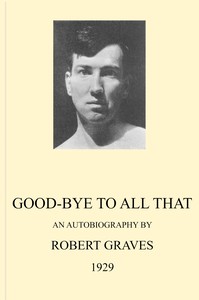
Robert Graves, 1929 Frontispiece
Cuinchy Brick-stacks seen from a British trench on the Givenchy canal-bank. The white placarded brick-stack is in the British support line; the ones beyond are held by the Germans. The village of Auchy is seen in the distance. (By courtesy of the Imperial War Museum.) To face page 152
Trench Map showing the Cambrin-Cuinchy-Vermelles Trench Sector in the summer of 1915. Each square-side measures 500 yards and is ticked off into 50-yard units. Only the German trench-system is shown in detail; a broken pencil-line marks the approximate course of the British front trench. The minecraters appear as stars in No Man’s Land. The brick-stacks in the German line appear as minute squares; those held by the British are not marked. The intended line of advance of the 19th Brigade on September 25th is shown in pencil on this map, which is the one that I carried on that day 190
Maps. (Reproduced by the courtesy of the Imperial War Museum.)
Somme Trench Map—The Fricourt Sector, 1916. This map fits against the map facing page 262 246
Somme Trench Map—Mametz Wood and High Wood, 1916. This map fits against the map facing page 246 To face page 262
Robert Graves, from a pastel by Eric Kennington 296
Various Records, mostly self-explanatory. The Court of Inquiry mentioned in the bottom left-hand message was to decide whether the wound of a man in the Public Schools Battalion—a rifle-shot through his foot—was self-inflicted or accidental. It was self-inflicted. B. Echelon meant the part of the battalion not in the trenches. Idol was the code-name for the Second Battalion the Royal Welch Fusiliers. The notebook leaf is the end of my 1915 diary only three weeks after I began it; I used my letters home as a diary after that. The message about Sergeant Varcoe was from Captain Samson shortly before his death; I was temporarily attached to his company 322
1929, The Second Battalion the Royal Welch Fusiliers back to pre-war soldiering. The regimental Royal goat, the regimental goat-major and the regimental pioneers (wearing white leather aprons and gauntlets—a special regimental privilege) on church parade at Wiesbaden on the Rhine. The band follows, regimentally. The goat has a regimental number and draws rations like a private soldier. ‘Some speak of Alexander, and some of Hercules....’ To face page 364
WORLD’S END
The tympanum is worn thin. The iris is become transparent. The sense has overlasted. Sense itself is transparent. Speed has caught up with speed. Earth rounds out earth. The mind puts the mind by. Clear spectacle: where is the eye?
All is lost, no danger Forces the heroic hand. No bodies in bodies stand Oppositely. The complete world Is likeness in every corner. The names of contrast fall Into the widening centre. A dry sea extends the universal.
No suit and no denial Disturb the general proof. Logic has logic, they remain Quiet in each other’s arms, Or were otherwise insane, With all lost and nothing to prove That even nothing can be through love.
LAURA RIDING
(From Love as Love, Death as Death)
GOOD-BYE TO ALL THAT
I
The objects of this autobiography, written at the age of thirty-three, are simple enough: an opportunity for a formal good-bye to you and to you and to you and to me and to all that; forgetfulness, because once all this has been settled in my mind and written down and published it need never be thought about again; money. Mr. Bentley once wrote:
The science of geography Is different from biography: Geography is about maps, Biography is about chaps.
The rhyme might have been taken further to show how closely, nevertheless, these things are linked. For while maps are the biographical treatment of geography, biography is the geographical treatment of chaps. Chaps who are made the subjects of biography have by effort, or by accident, put themselves on the contemporary map as geographical features; but seldom have reality by themselves as proper chaps. So that Who’s Who? though claiming to be a dictionary of biography, is hardly less of a geographical gazetteer than Burke’s Peerage.... One of the few simple people I have known who have had a philosophic contempt for such gazetteering was Old Joe, a battalion quartermaster in France. He was a proper chap. When he had won his D.S.O. for being the only quartermaster in the Seventh Division to get up rations to his battalion in the firing line at, I think, the Passchendaele show, he was sent a slip to complete with biographical details for the appropriate directory. He looked contemptuously at the various headings. Disregarding ‘date and place of birth,’ and even ‘military campaigns,’ he filled in two items only:
Issue . . Rum, rifles, etc. Family seat . My khaki pants.
And yet even proper chaps have their formal geography, however little it may mean to them. They have birth certificates, passports, relatives, earliest recollections, and even, sometimes, degrees and publications and campaigns to itemize, like all the irrelevant people, the people with only geographical reality. And the less that all these biographical items mean to them the more particularly and faithfully can they fill them in, if ever they feel so inclined. When loyalties have become negligible and friends have all either deserted in alarm or died, or been dismissed, or happen to be chaps to whom geography is also without significance, the task is easy for them. They do not have to wait until they are at least ninety before publishing, and even then only tell the truth about characters long dead and without influential descendants.
* * * * *
As a proof of my readiness to accept biographical convention, let me at once record my two earliest recollections. The first is being held up to the window to watch a carnival procession for the Diamond Jubilee in 1897 (this was at Wimbledon, where I had been born on 24th July 1895). The second, an earlier recollection still, is looking up with a sort of despondent terror at a cupboard in the nursery, which stood accidentally open and which was filled to the ceiling with octavo volumes of Shakespeare. My father was organiser of a Shakespeare reading circle. I did not know until long afterwards that it was the Shakespeare cupboard, but I, apparently, had then a strong instinct against drawing-room activities. It is only recently that I have overcome my education and gone back to this early intuitional spontaneousness.
When distinguished visitors came to the house, like Sir Sidney Lee with his Shakespearean scholarship, and Lord Ashbourne, not yet a peer, with his loud talk of ‘Ireland for the Irish,’ and his saffron kilt, and Mr. Eustace Miles with his samples of edible nuts, I knew all about them in my way. I had summed up correctly and finally my Uncle Charles of the Spectator and Punch, and my Aunt Grace, who came in a carriage and pair, and whose arrival always caused a flutter because she was Lady Pontifex, and all the rest of my relations. And I had no illusions about Algernon Charles Swinburne, who often used to stop my perambulator when he met it on Nurses’ Walk, at the edge of Wimbledon Common, and pat me on the head and kiss me; he was an inveterate pram-stopper and patter and kisser. Nurses’ Walk lay between ‘The Pines,’ Putney (where he lived with Watts-Dunton) and the Rose and Crown public-house, where he went for his daily pint of beer; Watts-Dunton allowed him twopence for that and no more. I did not know that Swinburne was a poet, but I knew that he was no good. Swinburne, by the way, when a very young man, went to Walter Savage Landor, then a very old man, and asked for and was given a poet’s blessing; and Landor when a child had been patted on the head by Dr. Samuel Johnson; and Johnson when a child had been taken to London to be touched by Queen Anne for scrofula, the King’s evil; and Queen Anne when a child....
But I mentioned the Shakespeare reading circle. It went on for years, and when I was sixteen curiosity finally sent me to one of the meetings. I remember the vivacity with which my mother read the part of Katherine in the Taming of the Shrew to my father’s Petruchio, and the compliments on their performance which the other members gave me. Mr. and Mrs. Maurice Hill were two of the most popular members of the circle. This meeting took place some years before they became Mr. Justice Hill and Lady Hill, and some years, too, before I looked into The Shrew. I remember the lemonade glasses, the cucumber sandwiches, the petits fours, the drawing-room knick-knacks, the chrysanthemums in bowls, and the semi-circle of easy chairs around the fire. The gentle voice of Mr. Maurice Hill as Hortentio was admonishing my father: ‘Thou go thy ways, thou hast tamed a cursed shrew.’ I myself as Lucio was ending the performance with: ‘’Tis a wonder by your leave she will be tamed so.’ I must go one day to hear him speak his lines as Judge of the Divorce Courts; his admonishments have become famous.