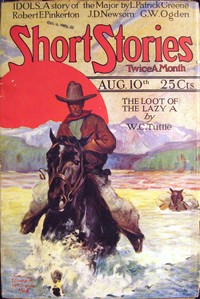
THE LOOT OF THE LAZY A
By W. C. Tuttle
Author of “Romance,” “Straight Shooting,” etc.
CULTUS COLLINS ONCE MORE STARTS OUT TO INVESTIGATE FOR THE CATTLE ASSOCIATION, AND FALLS INTO MORE ACTION THAN HE THOUGHT COULD BE FOUND IN THE WHOLE SOUTHWEST. AND THE END OF IT ALL WAS HIS OWN DISCOVERY THAT IT NEEDS MORE STRENGTH TO BE BEST MAN AT A WEDDING THAN TO BE BEST MAN IN A GUN-FIGHT--WITH WHICH ROLE CULTUS WAS ONLY TOO FAMILIAR
It was one of those foggy, raining, dismal nights, when all the world seemed one vast drip, drip of water; cold gusts of wind from the bay, where the fog warnings boomed dismally, boat whistles shrilled; while on the streets of San Francisco, little less wet than the bay itself, cable-car motormen danced jigs upon their gongs, seeking to clear the tracks, which they could hardly see in the dim glow of their own headlights.
Standing in the protection of a half lighted doorway, just outside the borders of Chinatown, was a girl. She was dressed in a black suit, black hat. Close inspection would have shown that both the suit and hat were slightly more than well worn, and were also very wet. She carried no umbrella. She was not beautiful, but perhaps it was because of the abject misery in her big, dark eyes, the utter helplessness of her expression.
She was of medium height, slender, white-faced. In fact, her face was so white against the gloom of the doorway, which blended with her black garb, that it seemed like a white mask suspended invisibly against a dark curtain. The wind swirled past the doorway, showering her with rain, but she did not draw back--only stared ahead, dumbly.
A policeman emerged out of the fog, peered at her, as he went slowly past, glanced up the street toward the clanging of a street car bell, and went on. Possibly he thought she was waiting for a car.
A man emerged from a doorway farther up the street, and came down past her. He was tall, rather slender, his head surmounted by a huge Stetson sombrero, which made him look gigantic in the dim light. His heels hit hard on the sidewalk, because of the fact that he was wearing high-heeled boots, and in one hand he carried a suitcase.
The street car clanged past before he could reach the corner; so he placed his baggage on the sidewalk, shoved his hands deep in his pockets and leaned against a post, almost directly in front of where the girl stood. He turned and looked directly at her, but turned back and drew his hat farther over his eyes. He shivered a little. He had no overcoat either.
A man came from the opposite direction, swathed in a heavy overcoat, whistling aimlessly. He was a big man, the collar of his coat touching the brim of his derby hat. He did not see the girl until he was almost past her. He stopped and came back to her. It is possible that he did not see the tall man, who leaned against the post.
“Hello, Kid,” he said ingratiatingly. “What are you doing out in the rain, all alone?”
The girl did not reply, but drew back against the wall. The tall man turned his head.
“No coat, no umbrella?” The man in the overcoat laughed. “Say, you must be up against it, Kid. You don’t look so bad. Snap out of it. Gee, you don’t need to shiver on a corner.”
“Will you please go away?” asked the girl. “I’m all right.”
“I’ll say you are, Kid--all right. I like you. Don’t be uppish. Come on, and I’ll show you a good time.”
“Please let me alone.” The girl spoke softly.
“Don’t try to kid me,” laughed the man. “You’re going with me and I’ll show you the best time----”
The tall man had stepped in behind him and a huge hand, which gripped like a vise, had fastened to his shoulder.
“The lady asked yuh to let her alone, yuh know.” The tall man’s voice seemed mild, apologetic.
The man squirmed quickly. “Who in hell are you?” he demanded.
“Names wouldn’t mean anythin’,” the other said mildly.
The man jerked loose. “Then keep your hands off me! This is none of your business! Now, trot along and let us alone.”
“Ma’am,” the tall man spoke softly, ignoring the threatening attitude of the other man, “do yuh want to go with this man?”
“I certainly do not.”
“I reckon that’s final, don’tcha think?” The big man in the overcoat possibly did not agree with this, and he was foolish enough to swing a right-handed blow at the head of the tall man. The overcoat was a serious handicap. His blow had only traveled half of its arc, when a thick, bony fist, seemingly weighted with lead, caught him under the chin, and he went backward into the street, where he went down in a heap.
The girl stifled a scream, but the tall man’s chuckle was reassuring.
“Did yuh know this man, ma’am?” he asked, caressing his right hand.
“No, I did not. I don’t know who he is.”
“Neither does he--right now. Ain’t it cold! I hate this kind of weather. I s’pose it’s because I live so much on the desert.”
“On the desert?” The girl spoke softly. “Where everything is clean and good--and the sunshine----”
“Have you lived there?”
“Ages and ages ago.”
The tall man peered closer at her. “Yuh don’t look old.”
“I’m twenty-two.”
The tall man laughed softly. “Yeah, yo’re sure ancient, ma’am. And yo’re all wet and shiverin’. Will yuh--? Say, that’s funny. I just knocked that feller into the street for askin’ yuh to go with him, and I was about to do the same thing. He’s gettin’ up.
“Yeah, and he’s goin’ the other way. He’s stoppin’ at the sidewalk, prob’ly wonderin’ what to do about it. Mebbe he don’t know what it’s all about.”
The man had staggered to the opposite sidewalk, where he stood, humped slightly in the rain. His derby hat was out in the street, but he did not seem to miss it. A policeman was coming down that side of the street, and they heard the man say something, which caused the officer to stop.
“C’mon,” said the tall man, grasping the girl by the arm. “Yuh never can tell what that jigger will tell the law.”
Shielding her as much as possible from the rain, the tall man picked up his suitcase and escorted the girl around the corner and down the block. She did not hold back. There was too much sincerity in the voice of this big cowboy for her to feel afraid.
“Where are we going?” she ventured to ask.
“I know a place,” he said jerkily. “It ain’t so much to look at, and lotsa ornery folks eat there, but they sure sabe how to cook a steak, and make soup. Do yuh like soup?”
“Soup?” The girl spoke the word queerly, as though it was something she had once known, but had forgotten.
“Yeah, that’s it. Lotsa onions and meat. Here we are.”
He led her up a rickety stairs, where the air was redolent with odors of frying meats, garlic; the hundred-and-one odors that make up the atmosphere of a bohemian chop-house, where no questions are asked.
No head waiter met them. In fact they were almost knocked down by a hurrying waiter, carrying a tray of dishes; a short-haired, broken-nosed individual; a one-time artist in the manly art of scrambling ears.
It was warm up there amid all those smells. The tall man led the girl to a vacant booth, which an anemic-looking waiter was cleaning up, and they sat down opposite each other. The tall man had placed his suitcase beside the entrance, where he could watch it. It was the first time they had had a good look at each other.
The girl’s face was slightly flushed now, and when she removed her dripping hat, she was really pretty. Her hair was a soft brown. The man’s face was long and bony, with a large nose, keen gray eyes and a big mouth. His cheek-bones were prominent, his hair of a neutral shade, neither blonde, brown nor red.
His hands were huge, bony-wristed, flecked with freckles. He was dressed in a cheap brown suit, flannel shirt, and his trousers were tucked in the tops of his high-heeled boots. The girl looked intently at him. There was no denying that he was homely. Then he smiled at her. She caught her breath for a moment--and smiled back at him.
He was not the same man when he smiled. She caught herself staring at him, while the waiter took their order, wondering that a smile should so absolutely change a man. The waiter went away, marveling at the appetites these two must have.
“Ma’am,” said the tall man gravely, “my name’s Collins. My friends call me ‘Cultus’; Cultus Collins, from Cuyamac.”
“And I am just Mary Smith,” she said simply. “They used to call me Mary Elizabeth--when I had friends.”
“When yuh did have, Mary Smith?”
“Yes.”
“Uh-huh. Mary Smith, how long since yuh ate a meal?”
“Why--er--this noon.”
“Yuh don’t need to lie to me, Mary Elizabeth. Callin’ yuh that ought to prove me yore friend--and yuh hadn’t ought to lie to yore friends.”
Mary Smith looked into the gray eyes of Cultus Collins, and decided not to lie, because he seemed to know that she lied.
“It wasn’t a very big meal,” she said slowly.
“It wasn’t any meal at all, Mary Smith.”
“No, I guess it wasn’t.” And then Mary Smith bowed her head on her wet arms and cried, while Cultus Collins upset a bottle of catsup, trying to pat her on the shoulder and tell her to quit crying. Several diners looked curiously at them, but they were of the breed that mind their own business.