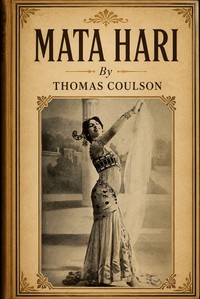
MATA HARI Courtesan and Spy
By MAJOR THOMAS COULSON, O.B.E.
HARPER & BROTHERS PUBLISHERS New York and London 1930
MATA HARI Copyright, 1930, by Harper & Brothers Printed in the U. S. A. SEVENTH PRINTING EIGHTH PRINTING
G-E
Illustrations are from the collection of W. Adolphe Roberts
To MITSOU
Preface
The romantic adventures of Mata Hari stirred a certain section of public opinion to a sympathy rarely accorded to spies. The men and women of that profession are usually the object of general execration from their enemies and a somewhat furtive admiration from others who extract pleasure or consolation from the pursuit of danger, where the degree and not the motive is the standard. Why, then, should this vaudeville “star” have excited a contrary emotion? Why should she have as defenders: princes, statesmen, savants, and artists, as well as genial boulevardiers who, if lacking in a supersensitive morality, are without doubt loyal citizens of the nation to which Mata Hari did incalculable harm?
In the first place, Mata Hari was a woman of unusual beauty, moving within a veil of sensual mysticism; in the second place, her chosen forum was Paris. The attention she had drawn as an artist and her subtle personality account for much of the interest she aroused. The fact that a Frenchman is never too fat, too old, or too ugly to be interested in a pretty (and frail) woman supplies the remainder of the answer to the problem. The average woman spy, outside of the popular romances, is not a lovable creature. But, endowed with a romantic nature, a rich imagination, a flair for the sensational, the sentimental, and the poetic, preaching a gospel of love which had to be communicated in whispered confidences, has this woman not all the characteristics of an ideal heroine for a successful novel?
Since the life and death of Mata Hari have become the common property of writers for the stage and more particularly for the screen, her fascinating history as a super-spy, dancer, courtesan, and high-priestess of a lascivious love cult with its wealth of drama, romance, and bitter tragedy, has been submerged beneath a torrent of highly imaginative literature which almost completely obscures the truth. No spy story is too absurd to be associated with her name; no deep-rooted intrigue too treacherous but that it becomes the more sinister by being made to revolve about her person. For the most part these flights of the artistic imagination bear too unmistakably the stamp of their manufacture to be worth exposing, but others, more subtly constructed, have passed into the current coin of espionage legend without any better claim to authenticity. The life of Mata Hari is romantic enough to require no embellishment, so that in the following narrative imagination plays no part in the drama it unfolds. No effort has been made to invent situations or conversations to promote the easy flow of the story.
Certain phases of Mata Hari’s life are inexplicable to those unaccustomed to the methods and practices of the secret services, and for this reason I have tried to illustrate the story with examples of other spies’ experiences. This knowledge of the German espionage work was collected while a regimental intelligence officer in Ireland, England, and France. The quoted examples of other spies are stories told me, for the most part, by men who were actually engaged in the work of counter-espionage which revealed their activities. It has been suggested that the narrative would be more convincing if the names of certain actors in the sensational story had appeared in the text. This could only have been done if the great game had terminated with the other hostilities on November 11, 1918. Unfortunately, that is not so. The scenes change, the task varies, but the work goes on. Reticence on certain points became not merely a matter of discretion, but of life and death to some of the men still engaged in the work of counter-espionage.
For instance, allusion is made in the text to a Russian courier who carried a draft treaty in the barrel of his fountain pen. I have been asked who was the courier and what treaty did he carry. To reveal these details would most certainly lead to the imprisonment, possibly the death, of a man who is still actively engaged in this dangerous work. It might be urged that the mere mention of the extraordinary hiding-place is evidence enough to betray the main characters. Happily it is not. But danger lies in the explanation. For purely diplomatic reasons other details may not yet be revealed, as will be understood from a reading of the text; too many trusted and influential people are involved. It is a great gulf that separates the foyers of the elegant Champs-Élysées from the bivouac fires; the vicious luxury of the demi-monde, sipping its cocktail with nice enjoyment, from the beer-swigging soldiers in the canteens; the lascivious dances of the worship of Siva from the grim Dance of Death on the crumbling parapets, where riven bodies were a commonplace. Yet over this yawning gulf between selfish lust and heroic self-sacrifice went the fluttering feet of the Red Dancer and her partner, Death, and the injury she did was tragic enough without adding to it by exposing people who, through accident or indiscretion, became involved.
T. C.
Mata Hari
COURTESAN AND SPY
Chapter One
The first time I heard the name of Mata Hari was in the fall of 1916. The association of her name with the inexplicable leakage of highly confidential information will best reveal how the woman’s sinister activities reacted upon men far removed from her physical existence. It will help to show why a spy incurs such deadly hatred among men not disinclined to face death when the danger may be boldly grasped, but who shudder with apprehension when some nameless and invisible enemy tries to encompass their destruction under the veil of assumed friendship which promotes an attitude of indifference among those whose duty it is to guard against such concealed activity.
Picture, then, a group of English soldiers straining their eyes into the abyss of night, waiting for the firing of a Verey light which will illumine a phenomenon just come within their knowledge. A patrol has just returned with the information that something mysterious has appeared in No Man’s Land that demands investigation. Scarcity of numbers in this sector had made increased watchfulness imperative and there was not a man among them who did not know No Man’s Land as intimately as he knew the details of his own back yard. But night plays fantastic tricks with the imagination and the eyes, so that when this newly returned patrol made its report there was no little uneasiness about the mysterious object set before their trench. Complete investigation, however, proved that this was no more than a crude notice-board bearing the scrawled enquiry, “Why wait for the 29th?”
Thus it came about that the bursting indiscretion of a mischievous Saxon soldier undid the work of a cunning spy. But we, who were the victims of the joke, were completely bewildered by this singular message which had come out of the night. Nor could our staff offer any enlightenment when we applied to them for an explanation. They were too busy with statistical computations of the consumption of plum and apple jam to gratify the misplaced curiosity of an enemy whose sense of humour usually had a more macabre touch. The incident would have been overlooked among more pressing anxieties and a tragedy would have resulted but for a chance visit the following day to some men who were training in the strictest seclusion for a special minor offensive.
These men were of my own company and at my suggestion were being trained for a night raid in full daylight. Night training is usually rendered farcical by the impossibility of adequate supervision, but with darkness simulated by the use of dark glasses we hoped to achieve a greater degree of efficiency. The work of these men was conducted in the utmost secrecy. No one other than about six officers had any idea of either the purpose, the locale, or the time of the raid. Living in such isolation, the raiders were always delighted to receive their rare visitors and listened with delight to the most trifling details of our battalion activities. As most people whose lives are anything but a joke are usually entertained by the feeblest jests, I was tempted to tell them of the enemy’s enigmatic enquiry, “Why wait for the 29th?”
The recital of this incident caused as much consternation as would have arisen in paradise had the devil dropped in for a social visit. Except, of course, for the blasphemy; that was supplemental, presumably. It appeared that the 29th was the date chosen for the secret raid and that our sector was to be the scene of the outburst. It was then the 26th. In spite of this unexpected betrayal after such elaborate precautions to maintain secrecy, the raid was carried out according to program in all its details except for the date. On the night of the 27th these men crept quietly out of the trenches, over No Man’s Land, and fell on an enemy taken completely by surprise. It would have been an unqualified success but for the unfortunate death of the young officer in command. On the return from the raid he was shot in the thigh and I was carrying him back to our trenches, when a bullet whipped through the night, penetrated his throat, and embedded itself in my shoulder. Just at the moment this happened he was about to tell me some secret of his last leave in Paris and his lips had just framed the words, “If we could only find that damned dancer ...” when they were closed by the great silence and his eyes turned to that dawn which knows no eventide.