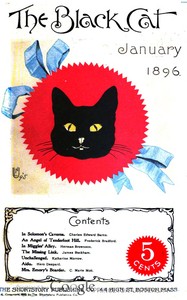
The Black Cat
January 1896.
Contents
=In Solomon’s Caverns.= Charles Edward Barns. =An Angel of Tenderfoot Hill.= Frederick Bradford. =In Miggles’ Alley.= Herman Brownson. =The Missing Link.= James Buckham. =Unchallenged.= Katharine Morrow. =Aidu.= Hero Despard. =Mrs. Emory’s Boarder.= C. Marie Mott.
5 CENTS
THE SHORTSTORY PUBLISHING CO., 144 HIGH ST. BOSTON, MASS. 4. Copyright 1895 by The Shortstory Publishing Co.
ADVERTISEMENTS
Mason & Hamlin Co.
The Mason and Hamlin Pianos are the only pianos manufactured containing the patented Screw Stringer, by virtue of which they do not require one quarter as much tuning as any other piano made: thus reducing expense of keeping and inconvenience to a minimum.
Full particulars and catalogues mailed free on application.
MASON & HAMLIN CO
BOSTON. NEW YORK. CHICAGO.
* * * * *
High Grade Salad for High Grade People
Book about real Olive Oil—Nature’s best refined—appreciated by folks of educated taste—free if you mail us your calling card—we don’t want postal card folks—A. G. Belden & Co., 145 Maiden Lane, New York, Importers.
* * * * *
Free Magic Lantern Book
All about lanterns, stereopticons and views, for Public Exhibitions—Schools—Home amusement and for everybody How to make money—265 page illustrated catalogue free.—Send to McALLISTER, 49 NASSAU STREET, NEW YORK.
* * * * *
Stock Buyers and Bankers
Take care of money—subject to check—give interest on deposits.
Buy and sell for cash or margin =ONLY= the securities listed on New York Stock Exchange
Investors of money
Givers of stock information, by mail or wire.
A member of our firm always on floor of Stock Exchange.
Wayland Trask & Co., 18 Wall St., New York.
The Black Cat
A Monthly Magazine of Original Short Stories.
No. 4. JANUARY, 1896. 5 cents a copy, 50 cents a year.
Entered at the Post-Office at Boston, Mass., as second-class matter.
=IMPORTANT.=—The entire contents of this magazine are covered by copyright and publishers everywhere are cautioned against reproducing any of the stories, either wholly or in part.
Copyright, 1895, by the Shortstory Publishing Company. All rights reserved.
In Solomon’s Caverns.
BY CHARLES EDWARD BARNS.
Three men stood in the doorway of the Bohemian Club, that meeting-place of men of the world from all over the world. It was the hour of noon, when the human tide in this busy quarter of San Francisco is at its height. Just as the party was about to separate, their way was temporarily blocked by a squad of policemen, who escorted a score or more of Chinamen handcuffed in pairs.
“What’s up?” asked one of the club-men.
“Opium smuggling,” replied the police captain.
“Speaking of opium,” said another of the trio, turning to his companions, “reminds me of an experience that befell a traveler in the Holy Land, an experience in which opium saved a man’s life.”
“Tell us about it.”
“It’s too long a story for the sidewalk, but if you will step upstairs and join me in a dish of frijoles, with etceteras, I’ll tell you all about it.”
“It happened in the ancient city of Jerusalem,” said the speaker, after they were seated in the Bohemian’s dining-room, whose walls bore picturesque record of many a “High and Low Jinks” in the club’s history. “Not many people know that the famous walled hamlet stands on a shell of rock; in other words, that there is a series of wonderful caverns extending for some miles in an intricate chain underneath the city, and that a little hole near the Golden Gate of the Holy Land, barely large enough to admit a man, is the only entrance and exit. These caverns, unlike the caves of Kentucky, were made by man. The stones which came from them were used in the building of Solomon’s Temple, just one thousand years before Christ. The old king employed eighty thousand men to cut out these stones, forty thousand working by day and as many by night, so you see that there must have been plenty of elbow room, and you can judge of the vastness of the present caverns. You remember the passage in 1 Kings,—that in the building of the temple ‘there was neither hammer, nor axe, nor any tool of iron heard.’
“One lovely spring morning, this man I’m telling about, who had a passion for out-of-the-way adventures, started for these caverns with a trusty dragoman guide, his mind bent on exploring the subterranean chambers further than had any one before him. In fact, he had a secret idea that he might discover a passage leading to the cavern under the pool of Siloam on the other side of the city; but this plan he kept to himself until he had reached the caverns, and spent an hour or more studying the marks left by the tools of Solomon’s workmen. When he finally revealed his scheme, the dragoman combated with the greatest vehemence an undertaking that, he said, might cost them their lives.
“Not at all affected by this dismal prophecy, which, in fact, added a certain relish to the adventure, the explorer took accurate bearings, and pressed on to what appeared to be the lowest spot in the whole series of caverns. Here, to his amazement, his guide sat down and absolutely refused to go farther. It was useless for his master to attempt to urge him on by the assurance that they could not be far from the south wall, where he hoped to find a connecting passage to the pool of Siloam. The old chap sat immovable, declaring that to go farther, provided as they were with but two torches and little food, meant certain death. He even appealed to Allah to restore his master to reason.
“But, guide or no guide, the explorer was determined to hang on to his project as a dog does to a bone. A few yards away rose a huge ledge that promised a better view of the caverns’ unexplored depths. Directing the dragoman to remain where he was seated and to answer whenever he heard his master’s call, he picked up his staff and started toward the ledge, promising that if he could find no outlet without going beyond calling distance he would give up his search. Once on his way to the ledge the man stopped, and, looking back to make sure that the dragoman understood his instruction, saw the old fellow sitting just as he had left him, the staff of his torch supported by his breast, so that the light shone full upon him, while his hands, which were thus left free, were rolling a cigarette, breaking an opium pill and sprinkling it into the tobacco, as was his custom. With a loud cry, which the guide returned in a deep guttural that resounded in a decidedly ghostly fashion in the grim caverns, the man passed on, lighted now only by the flame of his own torch. No sooner had he reached the high ledge than, seeing another still higher, farther on, he started for that, calling each moment, and as often hearing the sound of encouragement ever further and further away. Suddenly the answer, ‘Aiya!’ rose to a shrill scream, like that of a wounded animal. Instinctively he turned back, and called again. There was no answer. Another and yet another cry echoed vainly down the grim caverns. Seized with dread of some awful catastrophe, he rushed back the way he had come. When finally he reached his starting point he found, to his amazement, that the dragoman’s lamp was out; but by the light of his own he could see the man still sitting there in the hollow where he had left him, upright and motionless. Again he spoke, and again. The man made no reply. Then, thrusting his torch forward, he caught his first glimpse of the guide’s face, and stood rigid with terror. The bronze countenance was of a deathly pallor; the mouth was drawn as in agony, and the eyes were wide open,—so wide that the whites glowed through the darkness like phosphorescent globes. At the first touch the man fell heavily backward. As his master bent, attempting to raise the body, he saw, to his amazement, the torch, which he had laid aside, flicker and die. Then he understood. They were in a lake of deadly gas, which, being heavier than the air, had settled to the bottom of the cave. He groped for his torch, found it, and lighted it again, testing the lake of deadly carbon. Soon he found that if he lowered the light below his hips, when standing erect, it would go out. Thus he was half submerged in a lake of death, where he was safe only as long as he stood upright. Malook had seated himself, hence was literally drowned. Drawing a deep breath and holding it, he stooped and placed his hand on the guide’s heart. The action made him doubly sure of the deadly nature of the gas. The heart was still, and his own almost ceased beating in the brief moment spent in the suffocating carbon. But, even in the presence of death and danger, the instinct of self-preservation did not fail him. In a moment he had possessed himself of the dead man’s torch, his knapsack and luncheon, and his staff, and then, sacrilege though it seemed, he rifled his pockets. Here he found only tobacco and a box containing about a hundred little pellets of opium. These last he was about to put back, but, missing the pocket, he thrust the box into his own, and hurried to a higher and safer place. Once there, he set himself to puzzling out his next course of action. To make his way back to the entrance of the cave after these miles of wandering would be impossible. He had trusted his guide too implicitly for that. His only hope was to reach the pool of Siloam, which he was still doggedly convinced was not far away, although of a passage through there was no record. With this idea he started out once more, wandering aimlessly first this way and then that, finally bringing up, faint and exhausted, by the side of a body of still water. Grateful for this discovery, he scooped a little into his hands, bathed his hot head, and, as he was hungry, took a few mouthfuls of food. Finally, in the face of danger, just as has been told of famous generals in the thick of battle, he sat down and rolled a cigarette. The food and the tobacco, topped by a strong pull at his brandy flask, renewed his courage, and he set himself once more to reviewing the situation. From his extreme fatigue, he felt convinced that he had wandered miles. His legs ached as they never had before, and this, too, although he was accustomed to the severest mountain climbing. Looking at his watch, he was surprised to find that it was night in the world beyond and above him. Satisfied that even if he came near the passage to the pool the darkness would deceive him, he resolved to rest where he was until daybreak. An inventory of his supplies convinced him that he might fight off starvation for three days, but that at the extreme limit. Possessed by these frightful thoughts, he lay back, and, overcome by fatigue, soon fell into a slumber troubled by the most horrible dreams. In the midst of one of these nightmares he awoke with a scream, which resounded appallingly. The sense of desolation was almost unbearable. Indeed, if his torch had not been lighted, he would certainly have lost his reason. He knew that madness often preceded death under such circumstances, and in his desperation resolved that at the first signs of a failing mind he would put an end to his existence with his revolver. The case was desperate. Oil and food were low; above him stretched a crust of rock from forty to one hundred feet thick, through which no sound or ray of light from the outer world could penetrate. As a test of his courage, he put out his torch, but found that he could not endure the torture for long, though he resolved to inure himself to the strain of the intense darkness and silence, at any cost. Oil was now as precious as blood drops.